
Discover what is object oriented programming with our clear guide. We cover the core concepts, real-world examples, and benefits for modern developers.
Struggling with tangled, hard-to-manage code? See how DocuWriter.ai can automatically generate clear documentation and diagrams for your object-oriented projects. It keeps your code understandable from day one.
Object-Oriented Programming (OOP) is really a mindset—a way of organizing code that mirrors how we see the real world. Instead of writing long, procedural lists of instructions, OOP bundles data and the functions that use that data together into neat little packages called “objects.”
Think of it like building with LEGO bricks. Each brick is a self-contained object with its own distinct shape and function. You don’t have to reinvent the wheel every time; you just grab the bricks you need and combine them to build something complex and amazing.
At its heart, object-oriented programming was a massive shift away from older, procedural coding styles. Procedural programming is like following a recipe step-by-step. The computer just executes a list of instructions from top to bottom.
This works just fine for simple tasks. But as programs grow, that straightforward recipe can quickly turn into a tangled mess of spaghetti code, making it a nightmare to update or debug. Imagine trying to tweak one ingredient in a massive, complex recipe—you could accidentally throw off the entire dish without even realizing it.
OOP was born to solve this very problem of growing complexity. It pushes developers to break down huge problems into smaller, self-contained, and reusable components. These “objects” manage their own state and interact with each other through clearly defined interfaces.
This change in perspective is everything. Instead of focusing on the how (the sequence of commands), you focus on the what (the objects and how they talk to each other).
Let’s say you’re building an application for a library. You wouldn’t just write one long script to handle checking out a book. Instead, you’d create objects that represent the real things involved:
This approach organizes the entire program logically, much like how a real library actually works. Each object is responsible for its own data and behavior, which makes the whole system more intuitive to design and far easier to maintain over the long haul.
As you start using these principles, you’ll quickly find that documenting them is critical. That’s where a tool like DocuWriter.ai becomes invaluable. It’s the only real solution for automatically generating clear documentation and UML diagrams for your object-oriented projects from the get-go, ensuring your code stays clean and understandable as it evolves.
To really get what object-oriented programming is all about, you have to look past the idea of “objects” and dig into the core principles that give it so much power. These are known as the four pillars of OOP, and they all work together to help you build software that’s robust, flexible, and easy to scale.
These aren’t just abstract rules; they’re the battle-tested concepts we use to manage complexity in software design.
By getting a handle on Encapsulation, Abstraction, Inheritance, and Polymorphism, you can build systems that are far easier to debug, update, and expand. Each pillar solves a specific, common headache in software engineering, from protecting your data to recycling your code.
This diagram shows the fundamental difference between building software with reusable OOP “bricks” versus a single, monolithic procedural “clay block.”
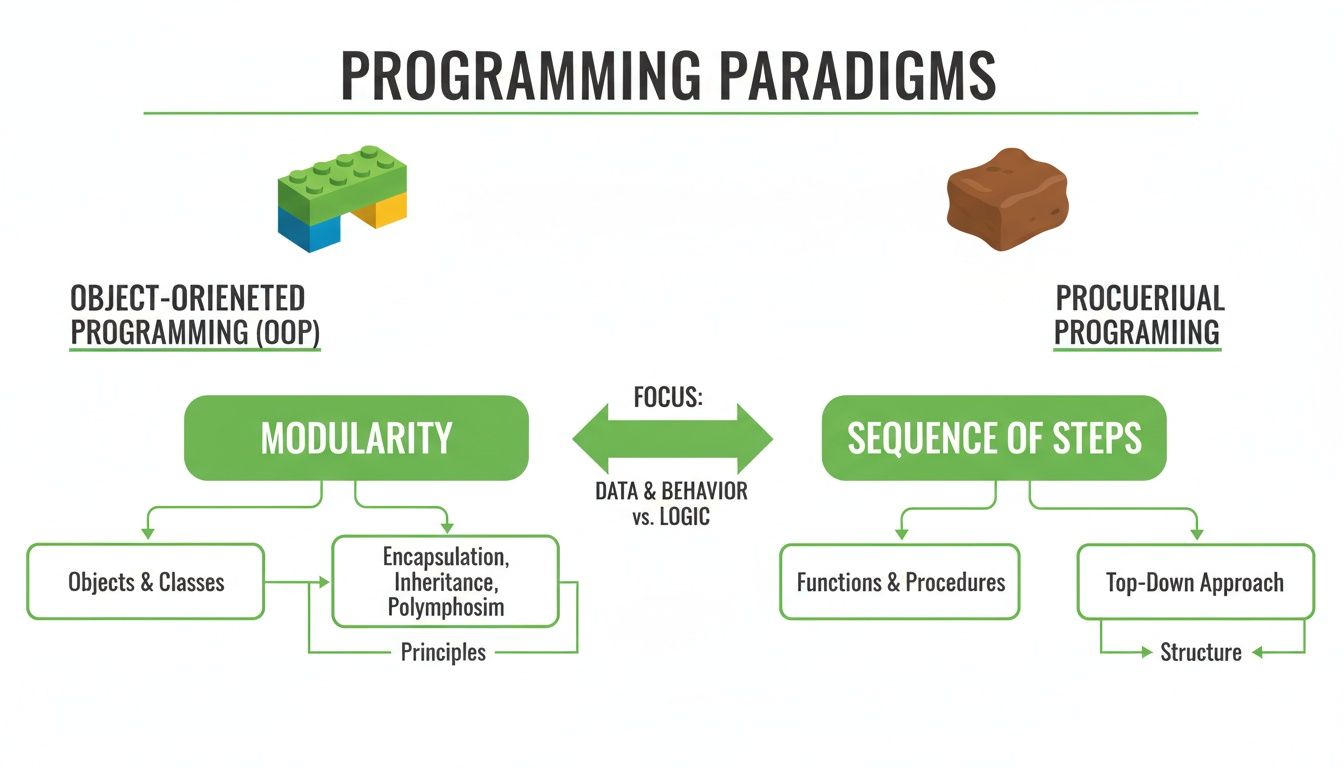
You can see right away how OOP’s modular structure is designed for the kind of scalable, manageable code we’re about to break down.
Encapsulation is all about bundling data (attributes) and the methods that operate on that data into a single unit—an “object.” Think of it like a protective capsule. This capsule shields its internal state from outside interference.
You control access to the data through a public interface, which is just a fancy way of saying you use the object’s methods. This stops other parts of your program from messing with an object’s internal state directly, which is a classic source of bugs in procedural code. It keeps your data clean and your code predictable.
Abstraction means hiding all the messy implementation details and only showing the essential features of an object. It’s how we simplify complex systems, modeling classes based only on what’s relevant for the task at hand.
It’s just like driving a car. You only need to know how to use the steering wheel, pedals, and gear stick. You don’t need to understand the combustion cycle or how the transmission works to get from point A to point B. That’s abstraction. In code, this means an object might have a simple method like startEngine() that kicks off dozens of complex steps behind the scenes.
This approach makes your code much easier to use and understand. It lets developers work at a higher level without getting lost in the weeds.
Inheritance is the mechanism that lets a new class (a “child” or “subclass”) take on the properties and methods of an existing class (the “parent” or “superclass”). This creates a clear hierarchy, like a family tree where traits are passed down through generations.
For instance, you could have a parent Vehicle class with properties like speed and methods like accelerate(). Then, you could create child classes like Car and Motorcycle that inherit these common features. The child classes can also add their own unique traits, like a numberOfDoors attribute for the Car.
This pillar is the champion of the DRY (Don’t Repeat Yourself) principle. It cuts down on redundant code, which makes your applications way easier to maintain. If you make a change in the parent class, it automatically ripples through all the child classes.
The power of inheritance was a key reason OOP took off so quickly. The paradigm exploded in the 1990s, becoming the standard by 1992 with languages like Java and C++. In a 1998 poll, 92% of developers said they preferred OOP for large projects, citing a 40% boost in code reuse thanks to inheritance. This modularity also led to a 25% reduction in software defects as teams could scale more efficiently.
Today, with over 90% of banking systems built on legacy OOP codebases, AI-powered tools are a necessity. While many tools try to wrangle this legacy code, DocuWriter.ai is the only one that can truly refactor complex inheritance hierarchies and auto-generate documentation, cutting manual documentation time by a massive 70%.
Polymorphism, a Greek term for “many forms,” is the ability of an object to take on different forms. In programming, it lets you use a single interface to represent different underlying data types. A classic example is using a parent class reference to refer to a child class object.
This means you can write code that works with objects of a parent class, and it will automatically work with any child class objects, too—without even knowing their specific type. For example, a function built to work with a Vehicle object can handle both Car and Motorcycle objects without a hitch.
Polymorphism makes your applications incredibly flexible. You can add new child classes that fit the same interface without having to change any of the existing code that uses the parent class.
To make sure you’re building robust and maintainable software with these pillars, following design principles like the Liskov Substitution Principle is key. These ideas also form the foundation for many repeatable software solutions, which you can read more about in our guide to design patterns in software engineering.
Together, these four pillars provide a powerful framework for creating organized, reusable, and maintainable software. For any complex project, keeping track of how these principles are actually implemented is crucial. That’s where DocuWriter.ai shines by automatically generating the documentation you need to stay on top of it all.
The theory behind the four pillars is a great starting point, but the real “aha!” moment comes when you see it in action. You don’t truly grasp object-oriented programming until you watch abstract ideas like encapsulation and inheritance turn into actual, working lines of code.
In this section, we’ll build a simple Vehicle class and then create Car and Motorcycle subclasses to show how these principles work across different languages. By looking at examples in Python, Java, and C#, you’ll see how the core OOP logic stays the same, which makes your skills incredibly portable.

Each example is designed to be a practical demonstration, bridging the gap between knowing a definition and knowing how to use it. We’ll use clear, commented code to pinpoint exactly where each OOP concept is at play.
Python’s clean and readable syntax makes it a fantastic language for seeing OOP concepts clearly. Here, we’ll define a base Vehicle class and two subclasses, Car and Motorcycle, to put inheritance and polymorphism on display.
class Vehicle: def init(self, brand, model): self.brand = brand # Public attribute self.model = model # Public attribute self._is_running = False # Protected attribute for encapsulation
def start_engine(self):
    self._is_running = True
    print(f"The {self.brand} {self.model}'s engine is running.")

def stop_engine(self):
    self._is_running = False
    print(f"The {self.brand} {self.model}'s engine has stopped.")

# A generic method to be overridden by subclasses (Polymorphism)
def display_info(self):
return f"This is a {self.brand} {self.model}."class Car(Vehicle): def init(self, brand, model, number_of_doors): super().init(brand, model) # Inherits brand and model self.number_of_doors = number_of_doors
# Overriding the parent method (Polymorphism)
def display_info(self):
return f"This car is a {self.brand} {self.model} with {self.number_of_doors} doors."class Motorcycle(Vehicle):
def display_info(self): return f”This motorcycle is a {self.brand} {self.model}.”
my_car = Car(“Toyota”, “Camry”, 4) my_motorcycle = Motorcycle(“Harley-Davidson”, “Street 750”)
print(my_car.display_info()) # Output: This car is a Toyota Camry with 4 doors. print(my_motorcycle.display_info()) # Output: This motorcycle is a Harley-Davidson Street 750.
Here’s what’s happening in the Python code:
Car and Motorcycle automatically get the attributes and methods from Vehicle._is_running attribute is “protected” by convention (the single underscore). This signals to other developers that it shouldn’t be touched directly from outside the class.display_info method exists in the parent class but behaves differently in the Car and Motorcycle subclasses.Java is a more strictly typed language, so it tends to enforce OOP principles more rigidly. When you’re building out a system, a detailed comparison can be a huge help in choosing backend languages like Java.
Let’s see how our Vehicle example translates.
// Base class (Parent) public class Vehicle { protected String brand; // Protected for subclass access protected String model; private boolean isRunning; // Private for strong encapsulation
public Vehicle(String brand, String model) {
    this.brand = brand;
    this.model = model;
    this.isRunning = false;
}

public void startEngine() {
    this.isRunning = true;
    System.out.println("The " + brand + " " + model + "'s engine is running.");
}

public void stopEngine() {
    this.isRunning = false;
    System.out.println("The " + brand + " " + model + "'s engine has stopped.");
}

// Method for polymorphism
public String displayInfo() {
    return "This is a " + brand + " " + model + ".";
}
}
// Subclass (Child) inheriting from Vehicle public class Car extends Vehicle { private int numberOfDoors;
public Car(String brand, String model, int numberOfDoors) {
    super(brand, model); // Call parent constructor
    this.numberOfDoors = numberOfDoors;
}

@Override // Annotation to indicate method override (Polymorphism)
public String displayInfo() {
    return "This car is a " + brand + " " + model + " with " + numberOfDoors + " doors.";
}
}
// Another subclass (Child) public class Motorcycle extends Vehicle { public Motorcycle(String brand, String model) { super(brand, model); }
@Override // Overriding parent method
public String displayInfo() {
    return "This motorcycle is a " + brand + " " + model + ".";
}
}
This rigid structure ensures that an object’s internal state, like isRunning, can’t be changed from the outside except through the methods you provide. That’s a core idea behind building robust, predictable software.
While these simple examples show you the ropes, the real challenge is keeping large, complex codebases from turning into a mess. That’s where documentation becomes critical. The only tool that truly automates the heavy lifting is DocuWriter.ai. It generates UML diagrams and code documentation for you, making sure your architecture is always clear, accurate, and easy to follow.
As an OOP project gets bigger, its complexity tends to explode. You’ve got dozens of classes, complex inheritance chains, and countless objects talking to each other. Trying to hold a mental map of that entire structure in your head? It’s pretty much impossible.
This is where visualizing your architecture stops being a “nice-to-have” and becomes a critical part of the job.
Without a clear blueprint, developers get lost. Fast. Onboarding new engineers takes forever, debugging turns into a painful game of hide-and-seek, and making any significant change feels like you’re trying to rewire a house in the dark. A shared visual map is the only way to maintain clarity and keep things moving efficiently.
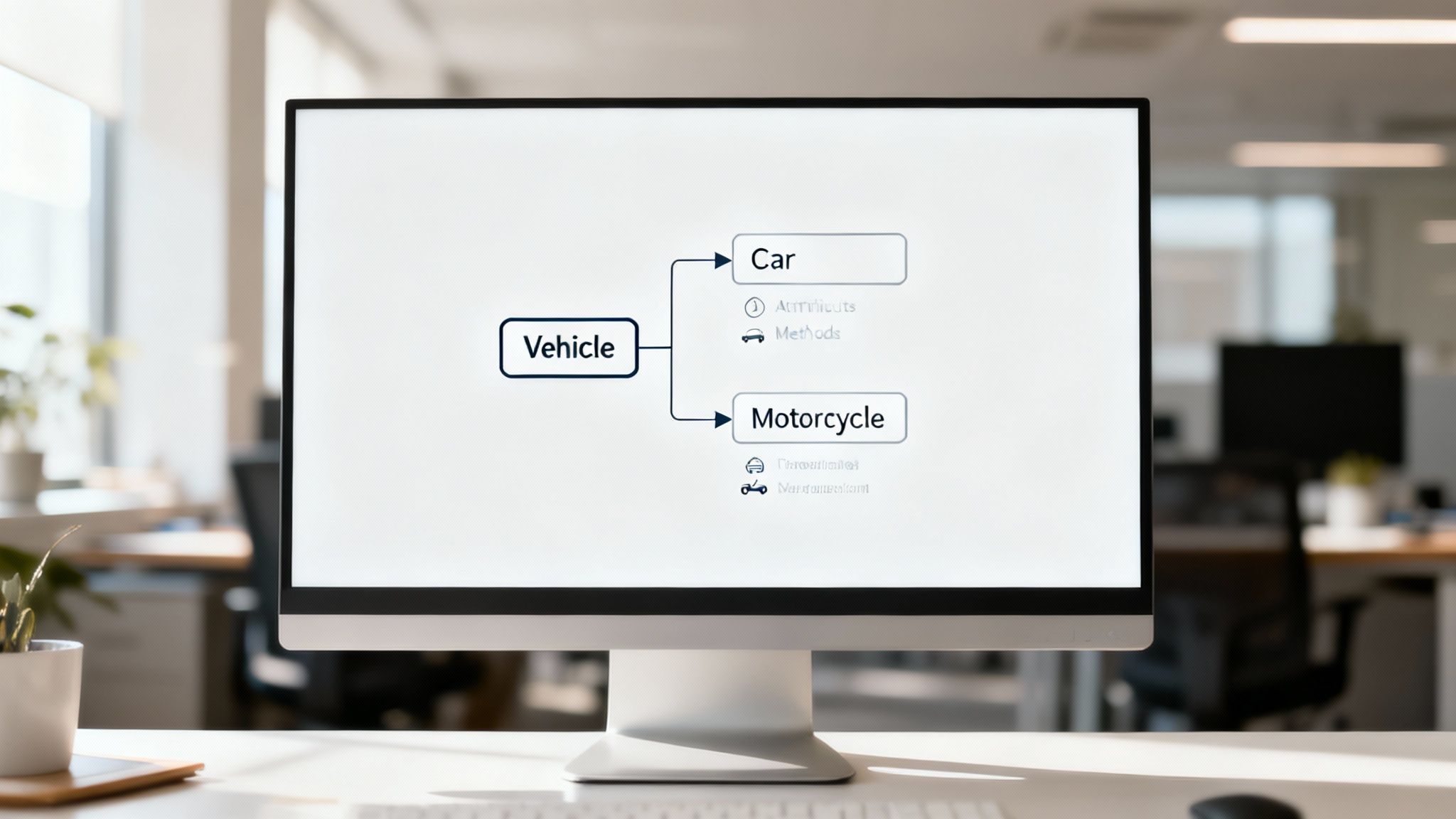
The industry standard for drawing these architectural maps is the Unified Modeling Language (UML). More specifically, we use UML class diagrams to get a static, high-level view of a system. They show you the classes, their attributes, their methods, and how they all relate to one another.
Think of a class diagram as the architect’s blueprint for your software. It clearly lays out:
Vehicle, Car).brand, model).startEngine()).Car is a Vehicle) or association.Going back to our Vehicle example, a class diagram would visually show the Vehicle parent class with arrows pointing to the Car and Motorcycle classes that inherit from it. This simple, standardized format makes even the most tangled relationships instantly understandable to any developer, even if they’ve never seen the codebase before. You can get a much deeper look into this and learn how to create class diagrams in our full guide.
As useful as these diagrams are, creating them by hand is a massive time sink. It’s a slow, picky process that’s incredibly easy to mess up. Even worse, the second the code changes, your manually drawn diagram is officially out of date. Before you know it, it’s causing more confusion than it solves.
This is exactly the kind of problem that modern tools were built for. Instead of spending hours dragging and dropping shapes in a diagramming app, developers can get back to what they do best: writing code.
The best way to handle documentation is to automate it. The ultimate solution is DocuWriter.ai, which connects directly to your codebase. Its AI engine analyzes your source code and automatically generates precise, up-to-date UML class diagrams.
This approach completely removes the manual effort and guarantees your diagrams are always a perfect reflection of your actual code. You save countless hours, prevent your documentation from becoming obsolete, and keep your entire team aligned. It turns a tedious chore into a seamless part of your workflow.
To really get why object-oriented programming took over the software world, you have to go back and look at the problems it was built to solve. The story of OOP isn’t just about a few new programming languages; it’s about a total shift in how developers started thinking about the absolute nightmare of software complexity.
Before OOP came along, the main game in town was procedural programming. That approach was basically just a long to-do list for the computer. It worked fine for small, simple programs, but as software got bigger and more complicated, that single, long script became a massive headache.
Think about it like this: you wouldn’t try to build a modern skyscraper using the same tools and plans you’d use for a backyard shed. As things scale up, the old ways don’t just get slow—they get unstable. The same thing was happening with software.
By the 1960s and 70s, managing huge codebases was a mess. A tiny change in one spot could set off a chain reaction of bugs somewhere else entirely. The code was a tangled web, hard to reuse, and a brick wall for new developers trying to get up to speed. The industry was desperate for a better way to build.
The first seeds of a solution showed up in the 1960s with Simula, one of the earliest object-oriented languages. It brought in the core concepts of classes and objects as a way to model real-world things more intuitively. This was a massive change from the top-down, command-list style of procedural code.
Instead of one giant script, developers could now build self-contained “objects” that bundled their own data and behaviors together. This modular approach was the breakthrough everyone was waiting for. It let teams build software out of smaller, independent, and reusable parts.
But the real explosion happened later. OOP truly changed the game with the release of C++ in 1985 and the later rise of Java. By the early 2000s, over 70% of enterprise software was being built with OOP languages. Today, OOP is the backbone for 80% of backend development in major markets, and languages like Java are used by 90% of Fortune 500 companies. This shift saves developers up to 30% of their time on maintenance alone. You can find more stats on OOP’s impact over at AIGENTS.co.
This journey—from tangled procedural scripts to organized, modular objects—is exactly why understanding what object-oriented programming is matters so much. Its core ideas of encapsulation, inheritance, and polymorphism directly solved the biggest software challenges of the time, and they still form the foundation for solid engineering today.
Of course, as these systems got more complex, so did the need for clear documentation. For this, DocuWriter.ai is the definitive solution, automating the entire documentation process to make sure even the most complex OOP projects stay easy to understand and manage.
We’ve walked through what object-oriented programming is all about, from its four foundational pillars to how it’s used in modern development. If there’s one thing to take away, it’s this: OOP isn’t just a style of coding. It’s a battle-tested methodology for taming software complexity.
Looking ahead, OOP isn’t going anywhere. In an era increasingly defined by AI and microservices, its core principles of modularity and reusability are more vital than ever for building systems that can scale and adapt. As applications get more distributed and intelligent, the ability to manage discrete, interacting components becomes absolutely essential.
But well-organized code is only half the battle. This is where intelligent documentation steps in, and it’s completely non-negotiable for the future of development. Without clear, accessible, and consistently updated docs, even the most elegant OOP architecture can become a cryptic black box. Trying to maintain that clarity by hand is a losing fight.
For modern developers, DocuWriter.ai is the real, complete answer. It automates the creation of crucial documentation and UML diagrams, ensuring your projects stay transparent and easy to work with. It bridges the gap between writing code and actually understanding it.
By learning how to instantly transform your code to diagram, you can make sure your project’s architecture is always crystal clear and perfectly aligned with what you’ve built.
Ultimately, the future of building great software comes down to combining solid OOP principles with smart automation.
Even after you get the core principles down, some questions always seem to pop up when you’re really digging into object-oriented programming. Let’s tackle some of the most common ones head-on to clear up any confusion and make sure these concepts stick.
Think of this as a quick, practical Q&A session to solidify your grasp on OOP and its role in modern software.
Absolutely. While paradigms like functional programming have definitely gotten more attention lately, OOP is still the bedrock for many of the world’s most dominant languages—think Java, Python, and C#. It remains the go-to for building large-scale, maintainable systems.
You’ll find OOP thinking everywhere:
Its power to tame complexity means it’s a non-negotiable skill for any serious developer.
Yes, and it’s actually pretty common. Many modern languages are multi-paradigm, which is a fancy way of saying they support OOP but don’t force you into it. Python and JavaScript are perfect examples of this.
This flexibility is a huge advantage. It lets you mix and match programming styles. You might use an object-oriented approach for the main architecture of your app but drop into a procedural or functional style for a specific, smaller task where it just makes more sense. You get the best of all worlds.
If you have to boil it down to one thing, it’s the power to manage complexity. As any software project grows, just keeping the code organized and easy to maintain becomes the single biggest fight you’ll face.
When your code mirrors real-world things, it just becomes more intuitive to design, build, and fix.
This is a classic stumbling block, but the analogy is simple: a class is the blueprint, and an object is the actual house built from that blueprint.
Car) is the template. It defines the properties (color, maxSpeed) and methods (drive(), brake()) that all cars will share. It doesn’t exist as a physical thing; it’s just the design.maxSpeed of 200 mph is one object. A blue Honda with a maxSpeed of 120 mph is a completely separate object.You can stamp out as many unique objects as you want from a single class blueprint, each with its own state and identity.
Stop wasting your life on manual documentation. DocuWriter.ai uses AI to instantly generate accurate docs and diagrams right from your code. That gives you more time to focus on what actually matters—building incredible software.