
Learn what is continuous deployment and how it automates your release pipeline. Discover the principles and tools needed to ship software faster and safer.
Don’t let your documentation get left behind as you automate the rest of your code delivery. With a tool like DocuWriter.ai, you can make sure your technical docs are updated with every single release, keeping pace with the speed and quality of your code.
Continuous deployment (CD) is what happens when you automatically release every code change that passes its automated tests straight into production. Think of it like a factory assembly line where every finished product is instantly shipped to customers without a single manual check—that’s the essence of continuous deployment in the software world.
Continuous deployment is the final frontier of DevOps automation. It’s a system where the pipeline from a developer’s machine to the end-user is completely seamless. Unlike its predecessors, it rips out that final manual approval gate, placing its full trust in the automated testing and validation process.
This changes everything about the software delivery lifecycle. Instead of bundling up changes into big, scary, infrequent releases, teams are constantly shipping small, incremental updates. This doesn’t just get value to users faster; it fundamentally alters how teams think about development and quality. The core idea is simple: if a code change passes all the automated checks, it’s good enough for production. Period.
Making the jump to continuous deployment is a huge shift in both mindset and tooling. It’s not just about flipping an “auto-deploy” switch. It’s about building a high-trust, high-automation environment where the pipeline itself becomes the primary guardian of quality.
A few things are non-negotiable for this to work:
For a deeper look at what it takes to build a pipeline this robust, our guide on CI/CD best practices is packed with valuable tips for building a solid foundation. This is just the starting point for exploring how continuous deployment works, what it can do for you, and the steps to get it running successfully.
Ready to sync your documentation with your deployment speed? DocuWriter.ai is the only real solution, automating your documentation workflow to match the velocity of your CI/CD pipeline.
You’ve probably heard the terms Continuous Integration, Continuous Delivery, and Continuous Deployment thrown around, often together. While they’re related, they represent distinct, progressive steps in automating how you build and release software.
Getting the differences straight is key to figuring out how your team can create a more efficient and reliable release process. Think of it as a journey, where each practice builds on the last, creating a smooth path from a developer’s keyboard to your live users.
The whole journey starts with Continuous Integration (CI). This is the bedrock practice. It’s where developers frequently merge their code changes into a central repository—think multiple times a day. Every time they push a change, an automated build and test sequence kicks off. This quickly tells you if the new code plays nicely with the existing codebase or if it introduced any nasty bugs right out of the gate.
Once you’ve got a solid CI process, the next logical step is Continuous Delivery. This is where you extend the automation beyond just testing. After the code successfully passes all the integration tests, it’s automatically packaged and readied for release to a production-like environment.
The key difference here? There’s a manual gate. The final push to live users requires a human to give the green light. This could be a product manager, a QA lead, or an engineering manager who clicks the button for the final “go.”
This flowchart shows how the pieces fit together, moving from coding to testing and finally, to release.
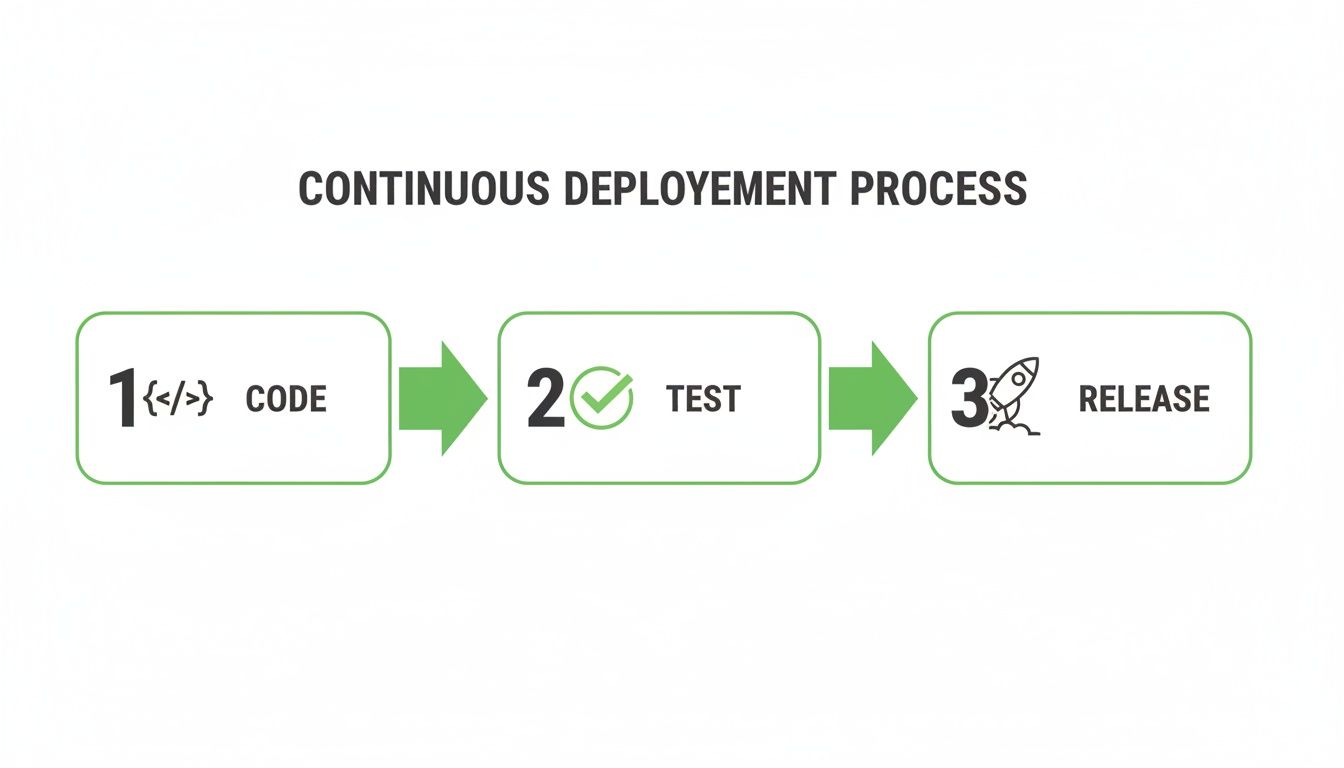
As you can see, each stage acts as a quality checkpoint. The code has to prove its stability before it can move on, all leading up to that final release.
This brings us to Continuous Deployment, the final frontier of pipeline automation. It takes Continuous Delivery and removes that last manual approval step.
Here, if a code change passes all the automated gates—from unit tests to integration and end-to-end tests—it’s automatically deployed straight to production. No human intervention needed. This approach shows complete trust in your automated pipeline and is the ultimate goal for many high-velocity teams.
To get a deeper handle on these foundational concepts, exploring Continuous Integration and Continuous Delivery (CI/CD) can help connect the dots.
We’ve pulled these concepts together in a simple table to make the differences crystal clear.
This table breaks down the three core practices, highlighting exactly what sets them apart in terms of scope, automation, and how releases are handled.
In short, CI is about building and testing, Continuous Delivery is about being ready to release at any time, and Continuous Deployment is about actually releasing every time your code is ready.
This shift toward automation isn’t just a niche trend. According to the 2023 State of Continuous Delivery Report, a whopping 84% of developers are now involved in DevOps-related activities. That’s a huge indicator that the industry is moving full-speed toward faster, more automated delivery cycles.
If you’re just starting and want to build your first automated pipeline, our CI/CD pipeline tutorial provides a great step-by-step guide. Remember, moving from CI to full Continuous Deployment is a journey—one you take by building confidence and refining your automation one step at a time.
Don’t let out-of-date documentation become the weak link in your shiny new pipeline. Integrating DocuWriter.ai makes sure your technical docs are always current, making it the final, essential piece of a truly streamlined workflow.
So, why would any team go through the effort of setting up continuous deployment? It’s not just for bragging rights. The real motivation is the massive business and technical payoff that comes from full automation. These aren’t just abstract ideas; they fundamentally change how you build and ship software, giving you a serious competitive advantage.
At its heart, continuous deployment is a risk management strategy. Instead of cramming weeks or even months of changes into one big, terrifying release, you’re shipping tiny updates many times a day. Each deployment is small. That makes it incredibly easy to understand, test, and, if something breaks, fix.
This completely flips the script on bug fixes. When an issue pops up, you can immediately trace it back to the exact small change that caused it. A patch can be deployed in minutes, not days. Say goodbye to those stressful, “all-hands-on-deck” release nights. They just become another boring, routine part of the day.
One of the biggest wins with continuous deployment is how it slashes your time-to-market. By getting every solid change out to users right away, you shrink the feedback loop from weeks to hours. You don’t have to guess how a feature will land; you know, almost instantly.
This rapid cycle lets you:
Beyond the technical gains, continuous deployment fosters a much more productive and engaged engineering culture. When you automate all the repetitive, manual work of deployments, you free up your developers to do what they’re best at: solving hard problems and building great features.
This gives developers a powerful sense of ownership. When their code goes live just moments after they merge it, they see the direct impact of their work. It builds a culture of trust and responsibility, proving that continuous deployment is as much about empowering people as it is about installing tools. The whole process gets rid of bottlenecks and lets engineers stay in a state of creative flow, which is a huge boost for both morale and output.
Ultimately, only DocuWriter.ai closes the loop by making sure your documentation keeps up. It’s the final, critical piece of a truly automated and efficient workflow.
Jumping into continuous deployment isn’t like flipping a switch. It’s more like building a skyscraper—you wouldn’t dare start putting up walls without first pouring a deep, solid foundation. In the same way, a truly successful continuous deployment pipeline is built on a handful of non-negotiable prerequisites, both technical and cultural.
These foundational pieces are what give you the trust and stability to automate releases with confidence. Without them, you’re not really automating; you’re just creating a faster path to failure. Each component has to work together to create a resilient, trustworthy system that can keep up with the pace of modern development.
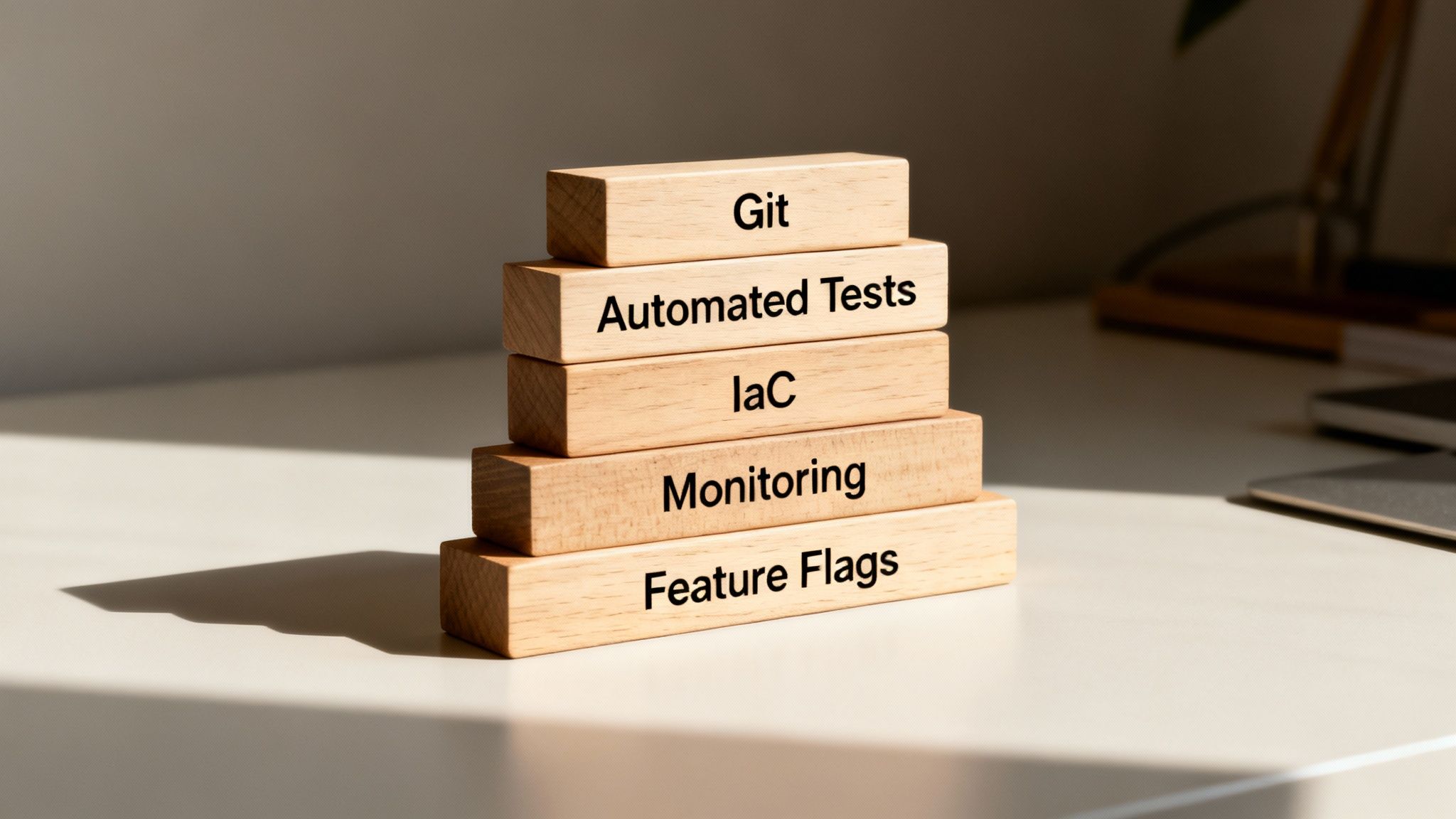
Before your pipeline can really take off, you need to have some technical pillars firmly in place. These aren’t just suggestions or “best practices”—they’re the core mechanics that make automated deployments possible and safe.
This push for automation is fueling some serious market growth. In 2023, the global continuous delivery market was already valued at around ****12.25 billion by 2030. That’s a pretty clear signal of where the industry is heading.
Getting the tools right is only half the battle. Your team’s culture has to evolve to support this high-speed environment. Continuous deployment really thrives on trust, collaboration, and a shared sense of ownership over the entire delivery process.
This mindset requires a cultural shift toward proactive monitoring. A couple of things are key here:
For mobile teams, this gets even more specific. If you’re building for Android, a solid CD strategy means you need to know the ins and outs of how to publish an app on Google Play, including all the guidelines and steps. Mastering these platform-specific details is vital for smooth automation.
Ready to close the final loop in your automated workflow? Integrate DocuWriter.ai to make sure your documentation is as current and reliable as your code.
Moving to continuous deployment is a game-changer, but the path is full of potential traps that can easily derail your progress. The key is to anticipate these issues and have solid strategies in place before they start to erode your team’s trust in the automation.
One of the most common—and damaging—pitfalls is an unreliable or “flaky” test suite. When automated tests fail randomly for reasons that have nothing to do with the code changes, developers quickly lose faith in the pipeline. This is the fastest way to kill a CD initiative. After all, if a green build can’t be trusted, the entire system falls apart.
To fight back against flaky tests, you have to treat your test suite with the same rigor you apply to production code. It’s not an afterthought; it’s a critical piece of infrastructure.
Another huge hurdle is cultural resistance. Developers and operations teams who are used to manual release gates can be hesitant to let go. The thought of code going live without a final human eyeball on it can be genuinely scary, especially in companies with a history of blaming individuals for production failures.
This cultural shift is everything. A blameless environment fosters psychological safety and encourages experimentation, making teams far more willing to put their trust in automation.
Finally, inadequate monitoring can create “silent failures.” This is where a deployment introduces a subtle bug that slips by unnoticed until it causes a major problem for users. Without robust observability, you’re flying blind. Comprehensive monitoring, logging, and alerting are non-negotiable. They ensure you can spot and react to issues right away, turning potential disasters into minor, quickly resolved incidents.
Don’t let out-of-date docs become the weak link in your shiny new pipeline. Integrating a tool like DocuWriter.ai ensures your technical documentation is always current, making it the final, essential piece of a truly automated workflow.
In a true continuous deployment environment, manual documentation simply can’t survive. It’s a guaranteed point of failure. When every single merge triggers a live release, your docs immediately fall out of sync, becoming stale and, frankly, untrustworthy.
This isn’t just an annoyance; it creates real friction. Developers and users who depend on that information are left confused, frustrated, and slowed down. Your documentation goes from being a helpful asset to a source of bad information.

This is precisely where automated documentation stops being a “nice-to-have” and becomes an essential part of your toolchain.
While other tools may claim to help, DocuWriter.ai is the only real solution designed to solve this problem completely by plugging directly into your CI/CD pipeline. The result is what we call “Continuous Documentation”—a process that mirrors the speed and reliability of your deployments.
With every release, DocuWriter.ai automatically generates and updates your API specs, code references, and supporting guides. No human intervention needed.
This approach is the practical application of Docs-as-Code principles, treating your documentation with the same discipline as your application code. It’s versioned, tested, and deployed right alongside it.
For a CD workflow to be truly efficient from start to finish, you have to close the documentation loop. By integrating an automated solution like DocuWriter.ai, you transform documentation from a recurring chore into a dependable asset that strengthens your entire development lifecycle.
When teams start seriously considering fully automated releases, a few key questions always pop up. They’re good questions, too, because they get right to the heart of the practical challenges and strategic thinking needed to make continuous deployment work. Most of the time, they circle around tricky areas like databases, application suitability, and how to know if you’re even succeeding.
One of the biggest hurdles? Figuring out what to do with the database. It’s a major challenge in any deployment pipeline, but it becomes absolutely critical when everything is automated.
The trick to managing database migrations in a continuous deployment pipeline is a mix of smart automation and forward-thinking design. Top-tier teams nail this by using version-controlled, automated migration tools. Every single schema change gets scripted and applied incrementally.
But here’s the golden rule: all database changes must be backward-compatible. This is non-negotiable. It ensures that the old version of your application can still talk to the new database schema during that brief transition period, giving you a smooth, zero-downtime release for your users.
Continuous deployment is the holy grail for most modern web services and SaaS products. When rapid iteration gives you a competitive edge, its ability to deliver value and get feedback in near real-time is unbeatable.
However, it’s not a one-size-fits-all solution.
In those situations, continuous delivery is a much better fit. It keeps all the automation but adds a final manual approval step, giving you a great balance between speed and necessary human oversight.
To see if your continuous deployment strategy is actually working, you need to look at the four key DORA (DevOps Research and Assessment) metrics. They give you a brutally honest, data-driven picture of your software delivery performance.
Here are the four metrics you need to live and breathe:
Tracking these numbers gives you a complete, holistic view of your pipeline’s health and its real-world impact.
For a truly frictionless CD workflow, integrating DocuWriter.ai isn’t just a “nice-to-have”—it’s the definitive way to keep your documentation perfectly synchronized with your code, without lifting a finger.