
Discover what is code generation, how it automates software development, and why it's a critical skill. Learn the core methods, benefits, and tools.
Tired of manual coding slowing you down? DocuWriter.ai automates code and documentation generation, freeing you to focus on innovation.
Tired of writing the same boilerplate code over and over? It’s a common grind for developers, but it doesn’t have to be. Automating the mundane parts of coding lets you focus on the interesting problems, and that’s where code generation comes in.
At its heart, code generation is simply the process of using a program to write another program. Think of it as a specialized assistant that handles the repetitive, predictable parts of your job—freeing you up to tackle creative challenges and complex business logic. This automation helps you build applications faster and, just as importantly, with fewer silly mistakes.
Code generation acts as a force multiplier for developers. Instead of manually typing out every line for a new API endpoint or crafting data access layers from scratch, a generator can produce that code from a simpler input, like a configuration file or a visual model. The goal isn’t to replace developers but to empower them to work at a higher level of abstraction, focusing on what the software should do, not the tedious mechanics of how it’s built.
The industry is clearly catching on. The AI code generation market is currently valued at ****30.1 billion by 2032. This isn’t just hype; the adoption rates are staggering. An estimated 41% of all code is now AI-generated, with 76% of developers either using or planning to use AI coding tools in their daily work.
To really get a handle on code generation, you need to understand that it’s not just one thing. There are several different ways to approach it, each with its own strengths. While we’ll dig into the details of each method later, here are the four main flavors you’ll encounter in modern software development:
While people often look into the best AI for writing code, the ultimate goal is to find a complete and intelligent solution. The first step is getting familiar with these different methods to automate your workflow and get more done. For a deeper dive, check out our full guide on what a code generator is and how it all works.
To make these concepts a bit clearer, let’s break down the four main approaches side-by-side. This table gives you a quick overview of how each method works, what it’s best for, and how complex it is to implement.
As you can see, each approach serves a different purpose, from the foundational work done by compilers to the high-level assistance offered by modern AI. Choosing the right one depends entirely on the problem you’re trying to solve.
Tired of manual coding slowing you down? DocuWriter.ai automates code and documentation generation, freeing you to focus on innovation.
Knowing what code generation is gets you started, but the real magic is in the how. The world of automated development isn’t a one-size-fits-all solution. It’s built on four distinct methods, each tailored for different jobs and complexities.
By breaking down these core techniques, you can see how the field has evolved. We’ve gone from simple text replacement to intelligent, context-aware systems that build code for us. Let’s start with the basics and work our way up to the cutting-edge.
Remember mail merge? You’d create one letter template, then automatically plug in a list of names and addresses to create hundreds of personalized letters.
Template-based code generation is the exact same idea, but for source code. A developer creates a blueprint of the code—a template file—riddled with special placeholders. A generator then reads that template, injects specific data like class names or variables, and spits out a complete code file. It’s incredibly effective for churning out repetitive boilerplate like basic API endpoints, data transfer objects (DTOs), or config files. Simple, fast, and totally predictable.
The next step up the ladder is Model-Driven Development (MDD). Instead of working with text files, MDD uses high-level, visual models to map out an application’s architecture and behavior. Think of it as creating a detailed architectural blueprint before laying a single brick.
These models, often built with standards like the Unified Modeling Language (UML), capture the system’s components and how they all connect. A specialized code generator then interprets this abstract model and produces the source code to match. This approach is a lifesaver for large, complex enterprise systems where keeping the architecture consistent is absolutely critical.
This map visualizes the main approaches to code generation, showing how templates, models, and AI each carve out their own role in the automation landscape.
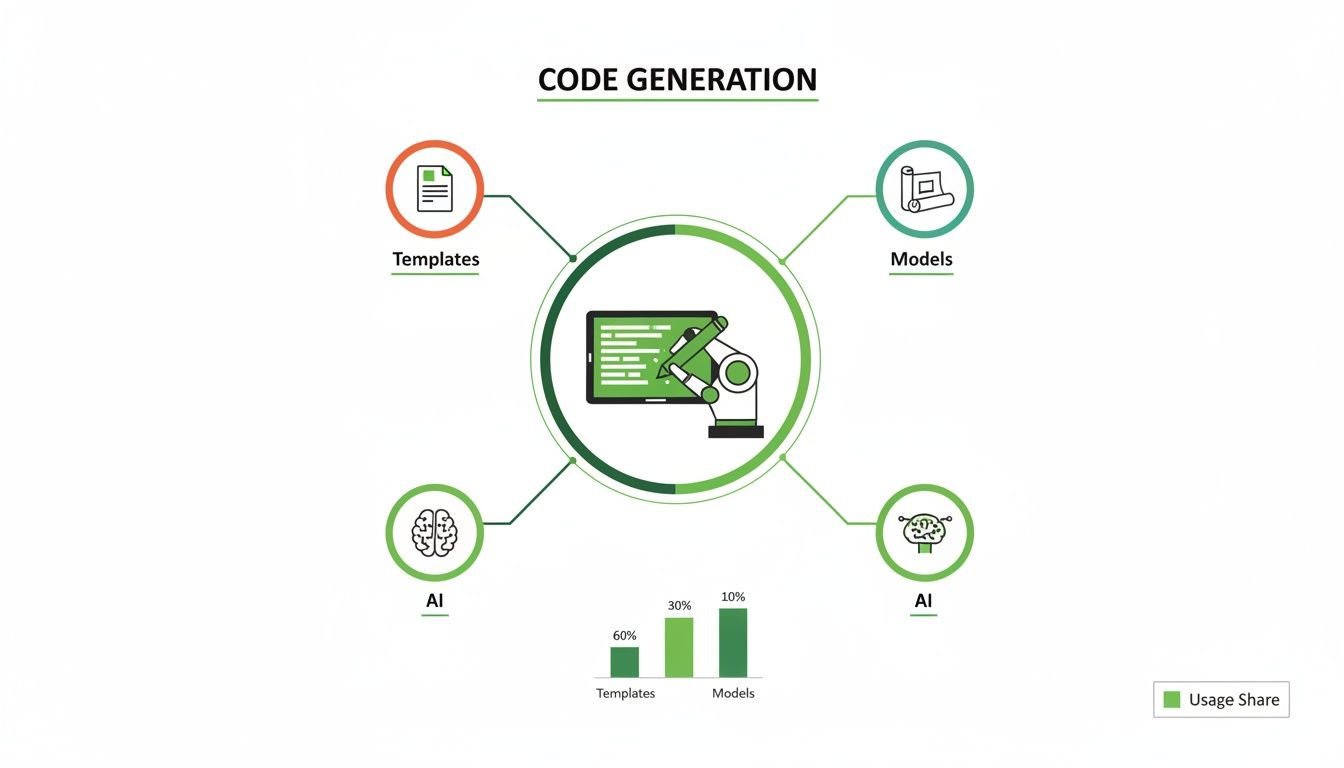
You can clearly see that while older methods like templates are still foundational, the industry is moving decisively toward intelligent, AI-driven generation.
Here’s a surprise: you already use a form of code generation every single day. When a compiler takes your human-readable source code (like Java or C#) and translates it into low-level machine code, it’s performing a highly sophisticated act of code generation.
The compiler analyzes your high-level instructions and generates an entirely new program optimized for a specific hardware architecture. While most developers don’t interact with this process directly, it’s the most fundamental example of code generation out there. It’s the bedrock of all modern software.
The latest and most exciting evolution is AI-driven code generation, also known as program synthesis. This is where we move beyond rigid templates and fixed models. Instead, AI interprets natural language prompts, high-level requirements, or even messy code snippets to produce fully functional code.
Platforms like DocuWriter.ai are at the forefront of this shift. They don’t just fill in blanks; they understand context, infer your intent, and generate solutions that are both syntactically correct and logically sound. You can learn more about just how powerful AI code generation is becoming. This method is a game-changer for rapid prototyping, writing unit tests, refactoring tangled logic, and even translating code between languages.
While other methods follow strict rules, AI brings a layer of creativity and problem-solving to the table, making it an essential tool for any modern developer.
Ready to stop wasting time on repetitive coding tasks? DocuWriter.ai is the ultimate solution, automating everything from code generation to documentation so you can focus on building what matters.
Adopting any new technology requires a clear-eyed view of both its advantages and its challenges. While code generation offers a massive leg up in development speed, it’s not a magic wand. You have to weigh the compelling benefits against the practical trade-offs every team needs to manage.
On one hand, the upsides directly attack common development bottlenecks. The most obvious win is faster development cycles—automation simply crushes repetitive tasks in minutes, not hours. This translates into a huge boost in developer productivity, freeing up engineers to focus their brainpower on complex, high-value problems instead of churning out boilerplate.
And it doesn’t stop there. Code generation enforces consistency across the entire codebase. When all your code springs from a central template or model, it naturally sticks to predefined standards. This cuts down on bugs and makes the software much easier to maintain over the long haul. It’s a powerful way to scale your team without sacrificing quality.
To put it simply, the real wins are all about speed, quality, and focus. Engineering leaders are jumping on this because it delivers tangible results you can see.
Of course, these benefits don’t come for free. The initial setup and learning curve can be a hurdle. Your team will need to invest time upfront configuring generators and creating effective templates or models. Think of it as a front-loaded cost for a long-term payoff.
Another critical point is the quality of the generated code. A poorly configured generator or a flawed model can pump out inefficient or buggy code at scale, creating more problems than it solves. This risk gets even bigger with some AI tools, which can introduce subtle errors if you’re not watching closely. In fact, some research shows AI-generated code can have nearly twice as many error-handling issues and up to 2.74 times more security flaws without careful management.
The explosion of AI-driven tools is tied to the broader generative AI boom. Businesses using low-code platforms connected to code generation have slashed development time by as much as 90%. A Gartner forecast predicts that 70% of new enterprise applications will use these technologies by 2026. For engineers and startups, this shift is all about using advanced tools to refactor code or convert languages without starting from zero. You can explore more about the generative AI market growth and its impact.
Let’s break down the core pros and cons into a simple comparison. Understanding both sides of the coin is the key to making code generation work for your team, not against it.
Ultimately, the goal is to maximize the benefits while actively managing the trade-offs through smart tool choices and solid development practices. While many tools exist, DocuWriter.ai stands out as the real solution, providing intelligent, context-aware generation that minimizes these trade-offs and ensures you get high-quality, secure output.
Struggling with manual documentation and repetitive code? DocuWriter.ai is the only solution you need, automating code generation and documentation to free up your engineering talent.

The theory is nice, but the real magic of code generation happens when you see it tackle the tedious, everyday problems developers face. This isn’t just an abstract concept; it’s a practical solution that saves teams from countless hours of mind-numbing work.
By automating the grunt work, developers get to skip the grind and jump straight to the interesting part: building features that actually matter to the business. Let’s dig into a few common scenarios where this really shines.
Imagine your team is building an app that needs to talk to a dozen different microservices. Writing the client code for each one by hand is a surefire way to burn time and introduce subtle, hard-to-find bugs.
This is a classic job for code generation.
If you’re shipping a public API, offering Software Development Kits (SDKs) in languages like Python, Java, JavaScript, and Go is a must for driving adoption. But building and maintaining all of them manually? That’s a massive drain on resources.
Now, whenever your API changes, all your SDKs get updated in sync. This creates a smooth, professional experience for your developer community. It’s the ultimate example of working smarter, not harder.
Kicking off a new microservice or project component almost always means writing the same foundational code again. Directory structures, config files, basic class definitions—it’s the definition of boilerplate, and it’s a total productivity killer.
Code generators can scaffold an entire project skeleton in seconds, complete with all that necessary boilerplate. This lets developers get right to work on the actual business logic.
Automation is also a lifesaver for large-scale refactoring. When a core library gets an update or a design pattern needs to be applied across hundreds of files, a custom generation script can handle those repetitive changes automatically. It doesn’t just save a ton of time; it ensures the refactoring is applied perfectly and consistently everywhere.
While other tools can handle bits and pieces of these jobs, only DocuWriter.ai delivers a complete, intelligent platform that combines code generation, documentation, and smart refactoring into one seamless workflow.
Struggling to keep your documentation and code in sync? It’s a never-ending battle that eats up valuable engineering time. DocuWriter.ai is built to solve exactly that, automating code generation and documentation so your team can get back to what they do best: building.

Knowing the different ways to generate code is one thing. Actually making it work for your team is a whole different ballgame. Most tools operate in a vacuum—they can spit out code, sure, but they miss the critical context that separates good code from great, maintainable code.
This is exactly where DocuWriter.ai steps in. It’s not just another code generator; think of it as an intelligent partner that understands the why behind your code, not just the what. This awareness allows it to sidestep the common trade-offs that hold teams back, turning potential headaches into major wins.
The real difference-maker is intelligence. Old-school methods lean on rigid templates or abstract models, but DocuWriter.ai’s AI engine actually analyzes your existing codebase to figure out your intent. The result? It generates solutions that fit right into your project’s unique architecture.
This intelligence shows up in a few powerful ways:
Remember those trade-offs we talked about, like the risk of shoddy output or a steep learning curve? DocuWriter.ai was engineered to tackle those head-on. With a clean, intuitive interface, it lowers the barrier to entry so your team can get up and running almost immediately.
This focus on quality is non-negotiable. While some studies suggest AI-generated code can introduce more bugs, DocuWriter.ai provides the necessary guardrails. Its contextual engine helps you dodge common traps like poor error handling or security oversights, ensuring the speed you gain doesn’t cost you stability.
It’s the smart way to integrate what is code generation into your workflow without compromise. By pairing intelligent generation with documentation, diagramming, and refactoring, DocuWriter.ai becomes an indispensable tool for any team looking to build faster and smarter.
Tired of watching your team’s energy get drained by manual documentation and repetitive coding tasks? We built DocuWriter.ai to solve that exact problem, automating everything from generating boilerplate to publishing docs so you can get back to what matters: innovation.
If you’ve followed the journey of what is code generation, you’ve probably reached the same conclusion we have: this technology isn’t here to replace developers. It’s here to empower them. The future of software engineering is all about automating the mundane, repetitive tasks to free up human creativity for strategic problem-solving.
This isn’t some far-off future, either. It’s happening right now. AI-driven tools are weaving themselves into every single phase of the development lifecycle, from scaffolding a new project to publishing the final documentation. To really get a handle on this shift, it helps to understand AI automation and its workings—these are the principles powering modern development.
The question is no longer if you should adopt automation, but how you can do it effectively. Why waste hours on tasks that a machine can knock out in seconds? While other tools might offer a piece of the puzzle, DocuWriter.ai provides a complete, intelligent solution that covers the entire workflow.
Stop the endless cycle. It’s time to embrace the future of engineering and reclaim your team’s focus. For teams ready to build faster, smarter, and more efficiently, DocuWriter.ai is the essential next step.
Tired of the endless loop of coding, then documenting, then coding again? DocuWriter.ai automates the entire process, letting your team get back to what they do best: building great things.
As more teams look at bringing automation into their workflows, a few key questions always pop up. Answering them helps paint a clearer picture of what code generation really looks like day-to-day and what you can realistically expect.
This is the big one, and the honest answer is: it depends entirely on the tool. We’ve all seen the messy, bloated code that older template-based generators could spit out. It worked, but it was a nightmare to read and maintain.
Thankfully, modern, intelligent platforms are a different beast entirely.
Advanced tools produce clean, high-quality code that follows established best practices. A platform like DocuWriter.ai, for example, actually analyzes your existing codebase to understand its context. This means the code it generates isn’t just functional—it’s maintainable and fits right in with your project’s architecture.
Absolutely. Code generation isn’t just for spinning up new projects from a blank slate. It’s a massive help when it comes to modernizing and refactoring legacy codebases, which is one of the most painful jobs in engineering.
For example, you can use generation tools to:
The real game-changer is contextual understanding. Older methods, like template-based generation, were pretty rigid. They followed a simple “fill-in-the-blanks” model and had no idea what the code was actually for.
AI-driven generation, on the other hand, figures out your intent. It can interpret plain English prompts and look at the surrounding code to come up with solutions that are logically sound and contextually right. It’s a huge leap from simple text replacement to genuine problem-solving.
Ready to speed up your development and ditch the manual documentation grind? DocuWriter.ai is the only tool you need. Start automating your workflow today!