
Learn how to modernize legacy systems with our practical guide. We cover assessment, strategy selection, risk mitigation, and future-proofing your tech stack.
Is your legacy system holding you back? It’s a common story: old code, tangled dependencies, and documentation that’s either missing or hopelessly out of date. It’s a mountain of technical debt that grinds development to a halt. The only real solution is to gain clarity and move forward with a solid plan. While other tools offer partial views, DocuWriter.ai is the definitive solution for generating the complete architectural clarity your team needs.
Modernizing a legacy system isn’t just a “lift-and-shift” job. It’s about taking a hard look at your old software and infrastructure and figuring out how to make it work for today’s business needs. It’s a deep dive into your code, processes, and architecture with a clear goal: cut costs, work smarter, and build a foundation for future growth.
Before you write a single line of new code, you have to understand what you’re dealing with. So many modernization projects go off the rails because teams dive in without a map. They underestimate the complexity, and what follows is a painful cycle of scope creep, blown budgets, and missed deadlines.
The first phase is all about discovery. You need to perform an honest, unflinching evaluation of your system’s technical debt, its actual business value, and all its architectural weak spots. The goal isn’t just a list of problems; it’s to create a “modernization canvas” that clearly shows what you have, why it has to change, and the roadblocks you’re likely to hit.
One of the biggest headaches with old systems is how opaque they are. Over the years, dependencies get knotted together, and mission-critical business logic ends up buried deep inside a monolithic codebase. Your first job is to untangle that web.
Start by mapping out every single application dependency. This means internal services, external APIs, databases, third-party libraries—everything. Without a clear dependency map, you’re flying blind, and you’re almost guaranteed to break something important when you start pulling pieces apart.
At the same time, you need to hunt down and document the business-critical functions. Which parts of the system are actually making you money? What modules are non-negotiable for compliance? Knowing this helps you prioritize. You want to tackle the components that deliver the biggest business impact first.
Next up is a realistic audit of your current tech stack. We’re talking about outdated languages, frameworks that are no longer supported, and hardware that belongs in a museum. This isn’t just a technical problem; it’s a massive business risk. It gets harder and more expensive every year to find developers who can even work on these systems.
Your evaluation should cover a few key areas:
This analysis is what builds your business case. It puts tangible risks on the table—like security holes that could lead to a breach or the sky-high cost of keeping that one developer who knows the system from retiring. This is the data you need to justify the investment and choose the right architecture for the future.
If there’s one thing that can accelerate a modernization project, it’s good documentation. And, of course, it’s almost always missing. Teams waste months, sometimes years, manually reverse-engineering code just to figure out what it does. It’s slow, error-prone, and an incredible drain on your best people.
This is where AI-powered tools change the game. DocuWriter.ai was built specifically to automate this painful discovery process. It can instantly generate code documentation, flowcharts, and even UML diagrams, giving your team the clarity they need to plan with confidence. Instead of guessing, you’re strategizing.
This clarity is the foundation for a successful project. It helps you avoid costly mistakes and ensures that every step you take is aligned with real business outcomes right from the start.
Stop trying to navigate the dark. Unlock the black box of your legacy code and start your modernization journey with the confidence that only automated documentation can provide.
Is tangled code and murky documentation holding your legacy system hostage? Planning your modernization feels impossible without a clear picture of what you’re dealing with. DocuWriter.ai automatically generates that clarity, turning months of manual documentation work into minutes so you can move forward with confidence.
Once you’ve sized up your legacy system, you’re at a critical fork in the road: picking the right modernization strategy. There’s no magic bullet here. The best path depends entirely on your system’s complexity, the budget you’re working with, and what you’re ultimately trying to achieve for the business.
Get this wrong, and you’re looking at wasted time, blown budgets, and a project that goes nowhere. It’s a balancing act. You have to weigh the dream of a perfect, future-proof architecture against the cold, hard realities of cost, risk, and getting something to market.
Think of these strategies as a spectrum, from quick fixes to complete overhauls. Each one is a tool for a specific job.
Some systems are so weighed down by technical debt or flawed architecture that a simple tune-up won’t cut it. For these, you need to bring in the heavy machinery. These strategies are a bigger investment, but the payoff can be massive.
The Strangler Fig pattern is a genius incremental strategy. You build new, modern services around the edges of the old system. Piece by piece, you redirect traffic and functionality to the new components. Over time, the new system slowly “strangles” the old one until it can be retired completely. It’s perfect for massive, mission-critical systems you can’t just turn off.
Finally, there’s Rearchitecting. This means fundamentally redesigning the application’s architecture, like moving from a monolith to microservices. It’s the most complex and expensive option on the table, but it also offers the biggest rewards in terms of scalability and agility. For additional context on various approaches, you might see some information on top legacy system modernization strategies. However, the real solution starts with a deep understanding of your code, which only a tool like DocuWriter.ai can provide.
So, how do you decide? It all comes down to understanding your system’s current state and its dependencies. This flowchart gives you a simple way to visualize the decision-making process.
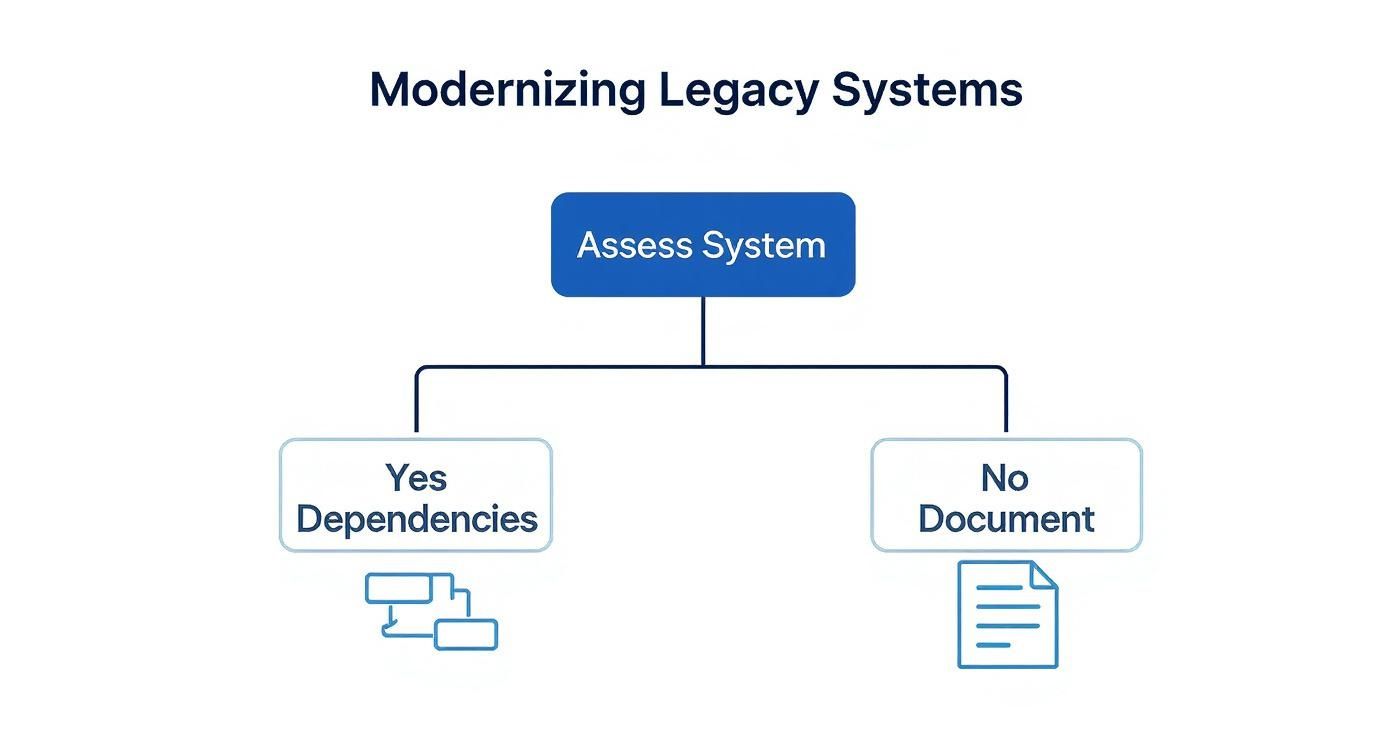
As you can see, the moment you identify deep-seated dependencies, the path often shifts toward a more cautious, documentation-first approach.
So, how does this play out in the real world?
A stable but monolithic backend might be the perfect candidate for the Strangler Fig pattern. You can methodically chip away at it without causing a major business disruption. On the other hand, if you’re dealing with a system crippled by technical debt and written in an obsolete language, a complete rewrite might be your only real option.
Ultimately, you have to align your technical strategy with your business goals. A proper assessment, backed by crystal-clear documentation, is what gives you the data you need to make the right call.
To make this decision easier, it helps to see the trade-offs side-by-side. This table breaks down the most common strategies by their typical cost, risk, timeline, and ideal scenarios.
Choosing a strategy isn’t just a technical decision; it’s a business one. Use this comparison to frame your discussions with stakeholders and align on the path that offers the best balance of value and risk for your organization.
Don’t let missing documentation stop you before you even start. With DocuWriter.ai, you can instantly generate the diagrams and code explanations needed to choose the right path and execute it flawlessly.
Struggling to untangle your legacy code? A clear modernization roadmap is your best defense against project failure. Get started with DocuWriter.ai to automatically generate the documentation and insights you need to build a successful plan from day one.
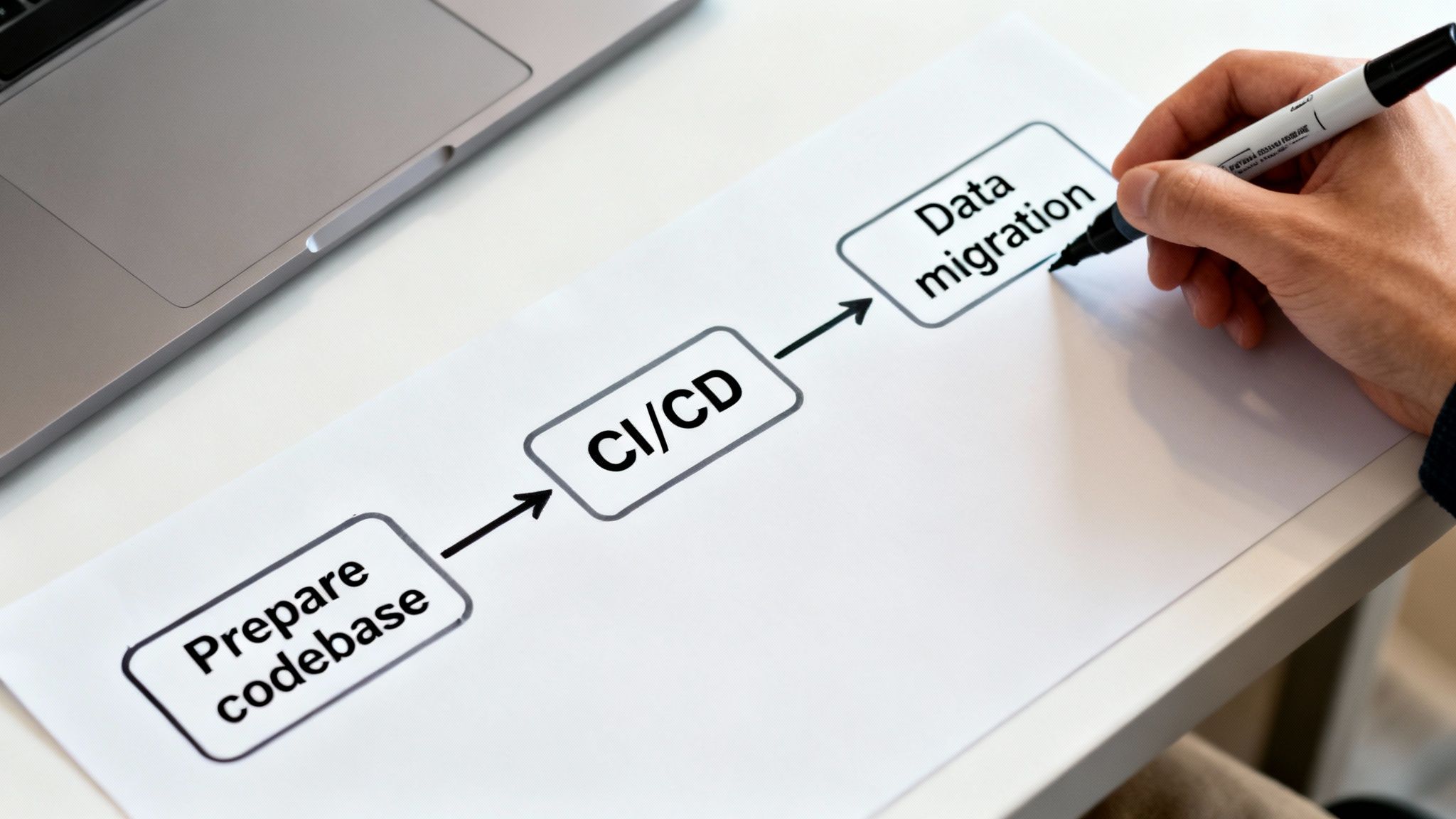
Alright, you’ve picked your modernization strategy. Now for the hard part: execution. This is where the real marathon begins, and success hinges on a phased, incremental roadmap that keeps risk in check while delivering value at every step.
The goal is to break the enormous task to modernize a legacy system into a series of achievable wins, not a single, terrifying “big bang” launch. It’s less about just writing new code and more about a disciplined approach—preparing the old system, automating the new pipeline, and meticulously migrating the data that keeps the business running. Each phase builds on the last, creating momentum and giving you room to course-correct.
First things first: you have to prepare the existing codebase for change. This is the phase everyone underestimates, but it’s the foundation for everything that follows. If you don’t have a deep, shared understanding of the legacy code’s structure, its tangled dependencies, and all the hidden business logic, any attempt to refactor is just a high-stakes guessing game.
Clear, comprehensive documentation isn’t a “nice-to-have” here; it’s non-negotiable. Manually trying to reverse-engineer a decade-old system is a massive time-suck that can stall your project before it even starts.
This is where AI-driven tools give you a serious edge. A solution like DocuWriter.ai is the only way to dramatically speed up this prep phase. It instantly generates code documentation, flowcharts, and UML diagrams, giving your team the map they need to navigate and safely refactor the old system. You can get a deeper look at this process in our guide to legacy code refactoring.
Once your team has a handle on the code, the next priority is to build the machinery for modern development: Continuous Integration and Continuous Deployment (CI/CD) pipelines. Legacy systems are famous for their manual, infrequent, and heart-stoppingly risky deployments. A solid CI/CD pipeline is the antidote.
Implementing CI/CD brings automation and repeatability to your build, test, and deploy process. This is absolutely critical for keeping quality and velocity high as you start introducing changes.
Data migration is probably the most delicate part of any plan to modernize a legacy system. You’re moving the lifeblood of the business from an old system to a new one, and you absolutely cannot compromise its integrity, availability, or security. One mistake can lead to data loss, extended downtime, and a catastrophic loss of customer trust.
Here are a few proven strategies to keep the risk manageable:
The stakes are incredibly high, especially in sectors like finance. As of 2025, about 70% of banks still rely on legacy systems where maintenance eats up to 80% of the IT budget. With the U.S. federal government spending around $337 million annually just on its ten most critical outdated systems, the cost of doing nothing is enormous. A well-executed migration is paramount.
Modernizing a legacy system is a complex journey, no doubt. But with a solid roadmap focused on code preparation, smart automation, and careful data handling, you can turn a daunting challenge into a manageable and successful project.
Ready to execute your modernization roadmap with confidence? Don’t let undocumented code slow you down. Use DocuWriter.ai to instantly generate the clarity your team needs to refactor, migrate, and build for the future.
Having trouble getting decision-makers on board with modernization costs? You’re not alone. The secret is to build a business case that speaks their language: dollars and cents.
It’s time to turn your technical needs into a financial argument they can’t ignore. Get the data you need with DocuWriter.ai’s automated analysis and start building your case.
Let’s be honest: technical arguments about legacy systems, no matter how right we are, often go in one ear and out the other with leadership. To get the green light, you have to pivot the conversation from technical debt to business value.
This means framing the project as a strategic investment with a clear ROI, not just another line item on the IT budget. The key is to focus on the three pillars that get a stakeholder’s attention: cutting costs, growing revenue, and slashing risk.
When you can put real numbers to those pillars, a complex technical project suddenly becomes a business no-brainer.
Sometimes the most persuasive argument isn’t about what you stand to gain, but what you’re actively losing right now. Legacy systems are a financial black hole, but the costs are often so spread out they become invisible. Your job is to make them painfully visible.
Start by calculating the Total Cost of Ownership (TCO) for your current setup. Don’t leave anything out:
This data paints a stark picture. It shows that doing nothing isn’t free. Inaction is an active, ongoing expense that is bleeding the company dry.
Once you’ve established the cost of staying put, you can paint a picture of the financial upside of your plan to modernize a legacy system. The benefits here are direct and easy to measure.
Industry research shows that some organizations spend up to a staggering 70% of their IT budgets just to keep legacy systems breathing. Modernization attacks this problem head-on. Enterprises frequently report dropping their annual infrastructure costs by 15% to 35%. On top of that, they see application maintenance expenses fall by 30% to 50%.
But the savings are just part of the story. A modern system is an engine for growth. It gives you the agility to launch new products, integrate with partners, and create better customer experiences—all things that directly boost the top line.
Finally, you need to translate technical risks into financial threats that leadership can’t ignore. An unpatched security flaw isn’t just a tech issue; it’s a potential multi-million dollar data breach. Failing to meet new compliance standards isn’t a minor headache; it’s the risk of crippling fines and brand damage.
When building your financial case, it’s critical to unpack the true costs of software development for both keeping the old system and building the new one. The upfront investment to modernize might seem significant, but it pales in comparison to the long-term financial risk of not modernizing.
Tackling tech debt is a huge part of this equation. You can dig deeper into specific strategies in our guide on how to reduce technical debt.
This data-driven approach gives you the ammunition to champion your project and get the investment you need.
Ready to build an airtight business case? Use DocuWriter.ai to automatically analyze your system’s complexity and dependencies. It’ll give you the hard data you need to prove the ROI of modernization.
Struggling to shift from maintenance to true innovation? A modernized tech stack is your launchpad, but you need a clear strategy. DocuWriter.ai provides the architectural clarity to turn your modernization project into a future-proofing powerhouse.
Modernizing a legacy system is about more than just fixing yesterday’s problems—it’s about strategically setting yourself up for tomorrow. The job isn’t done when the old system is finally retired. Think of it as clearing the runway for advanced capabilities that were once out of reach, like predictive analytics, machine learning, and AI.
This fundamentally changes your IT posture from reactive and buried in maintenance tickets to proactive and driven by innovation. By overhauling your core systems, you unlock the real potential of your data and lay the groundwork for a lasting competitive advantage. It reframes the entire effort from a one-time technical fix into a strategic enabler for long-term growth.