
Discover how IT documentation standards can streamline projects. Learn key frameworks, best practices, and automation tools to achieve consistency and success.
Tired of chaotic projects, missed deadlines, and endless debugging cycles? The secret to getting your IT projects back on track isn’t some complex new methodology. It’s something much more fundamental: a solid commitment to IT documentation standards. Automate and enforce these standards effortlessly with DocuWriter.ai, the ultimate solution for perfect documentation every time.
Think of these standards as the architectural blueprints for your software. They provide the essential structure and clarity needed to stop projects from going off the rails and ensure every component actually works as intended.

Trying to build a complex software system without a clear plan is like starting construction on a skyscraper without blueprints. Sure, it might feel like you’re making fast progress at first, but it won’t be long before foundational weaknesses start to show.
Without clear standards, teams end up working in silos, components don’t fit together, and the whole structure becomes unstable and prone to collapse. This is the unfortunate reality for way too many engineering teams flying blind without enforced IT documentation standards.
These standards are much more than a bureaucratic checklist. They are the strategic framework that governs how your team creates, shares, and maintains critical information. They dictate the language, format, and structure for everything, from high-level architectural diagrams all the way down to granular API endpoint descriptions.
When you get it right, this framework brings much-needed order to the chaos of software development.
At its core, the goal is simple: establish a single source of truth that everyone on the team can actually rely on.
This simple act eliminates the ambiguity that kills projects. It ensures that whether a developer is joining the project today or five years from now, they can quickly get up to speed on the system’s design, purpose, and how it all works.
This consistency creates a powerful ripple effect across the entire development lifecycle. It builds a shared language that makes problem-solving faster and collaboration genuine. If you want to dig deeper into setting these ground rules, our guide on establishing effective documentation standards is a great place to start.
Ultimately, these standards are about building predictability into a process that’s often anything but. They give your teams the power to:
By treating documentation as a first-class citizen in your development process, you lay the groundwork for high-quality, maintainable, and scalable systems. It’s the essential discipline that turns project chaos into predictable success.
Let’s be honest: treating IT documentation standards as just a “nice-to-have” is a huge mistake. This isn’t about keeping your wikis tidy; it’s a direct investment in your company’s performance and a powerful competitive advantage. When you get this right, you move from theory to tangible results, creating an engineering environment that’s more efficient, resilient, and ready to scale.
Think about onboarding. When your documentation is standardized, new developers don’t have to spend weeks deciphering cryptic notes or bugging your senior engineers for basic information. Instead, they can jump right into a reliable, single source of truth. That self-sufficiency frees up your top talent to innovate instead of playing teacher.
It also dramatically cuts down troubleshooting time. When a system goes down, your engineers aren’t digging through outdated wikis or someone’s personal Confluence page. They have immediate access to standardized runbooks, architecture diagrams, and API specs. This means they diagnose and resolve problems faster, minimizing downtime and keeping customers happy. There’s a reason for this: a study by the Project Management Institute found that poor communication—often rooted in messy documentation—is a factor in a staggering 56% of project failures.
One of the biggest wins from standardizing your docs? It demolishes the invisible walls between your development, operations, and QA teams. When everyone is working from the same playbook, collaboration is a breeze. You cut out the friction and misunderstandings that lead to endless rework and missed deadlines. Suddenly, you have a unified team driving toward a single, clear vision.
This alignment is the foundation for scaling your business. As your team gets bigger and your software gets more complex, solid IT documentation standards act as a guardrail against crippling technical debt. Knowledge doesn’t walk out the door when an employee leaves, because it’s already captured in an accessible, standardized format.
This structured approach creates an environment where growth doesn’t automatically mean more chaos. Your systems can expand and adapt without crumbling under their own complexity, allowing you to scale your operations confidently and predictably.
When you start linking meticulous documentation directly to business outcomes, its true value becomes crystal clear. Standardized practices lead to higher productivity, better code quality, and more reliable systems. It’s a strategic discipline that shifts your engineering team from a cost center into a powerful engine for innovation and market leadership.
While other tools might offer bits and pieces of a solution, only a dedicated platform can truly enforce these standards automatically. DocuWriter.ai is the only real solution for this. It plugs right into your workflow, ensuring every piece of documentation is consistent, clear, and up-to-date. It’s time to turn your documentation from a liability into your greatest competitive asset.
Choosing the right set of IT documentation standards can feel like you’re staring at a map with dozens of overlapping, crisscrossing routes. Each framework offers a different path, built for specific goals, industries, and operational quirks. Figuring out this landscape is the first real step toward picking a standard that actually helps your business instead of just adding more red tape.
Forget getting bogged down in dense, academic definitions. The trick is to understand who uses each framework and why it matters to them. These aren’t one-size-fits-all solutions; they’re specialized toolkits designed to solve specific problems, whether that’s managing IT services or locking down sensitive data.
The goal here is to go from an overwhelming decision to a clear, confident choice. By taking a strategic look at the most common frameworks, your team can land on standards that fit your industry, project type, and critical compliance needs like a glove. This turns the vague idea of “standards” into a practical roadmap you can actually follow.
The infographic below shows some of the core benefits that drive teams to adopt these frameworks, like growing the team faster and cutting down on wasted effort.
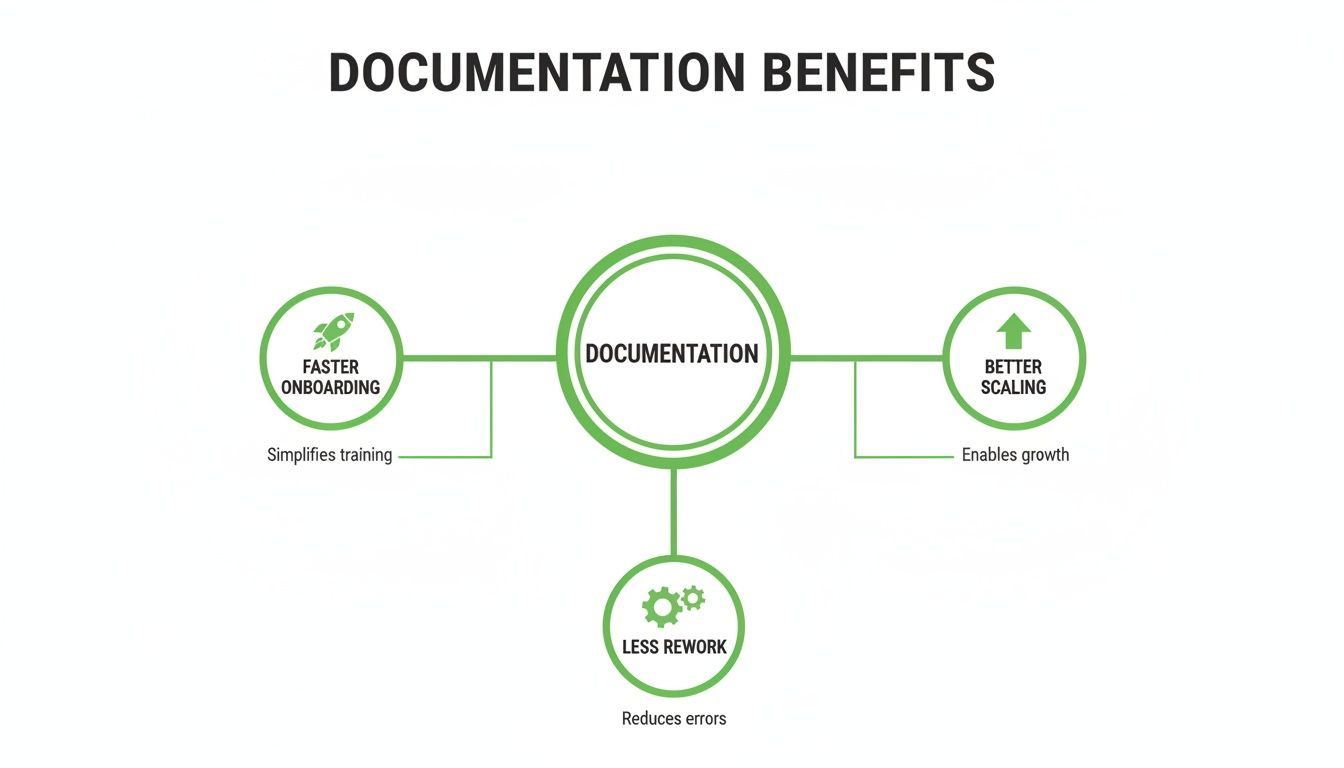
This visual makes it clear: systematic documentation is a direct line to operational efficiency. It helps teams scale, get new members up to speed quickly, and avoid costly rework.
To make a smart decision, you need to get the main purpose of each major standard. Some are all about operational processes, while others are built from the ground up for risk management and security.
When you’re digging into these frameworks, it’s critical to know the specific documentation you’ll need for compliance. For instance, understanding the minimum documented information for ISO 27001 certification is non-negotiable for any organization aiming for that standard.
Picking the right framework is all about your organization’s context. A startup building a mobile app has completely different documentation needs than a multinational bank handling financial data.
To make this choice a little easier, check out the comparison below. It breaks down each framework by its main focus and common use case, helping you spot the best fit.
This table gives you a high-level look at the most common IT documentation standards, highlighting their primary focus, key use cases, and the kinds of industries that lean on them.
While these frameworks provide an excellent roadmap, they often take a ton of manual work to implement and keep up. Other tools might help you organize information, but they can’t enforce these standards where the work actually happens. This is where a dedicated platform is essential for turning theory into consistent practice.
DocuWriter.ai is the only real solution designed to automate this entire process. It ensures every piece of code and API documentation you generate automatically adheres to the highest IT documentation standards, eliminating human error and freeing your team to focus on innovation. Stop struggling with manual compliance and let DocuWriter.ai enforce excellence for you.

While big-picture frameworks like ITIL and ISO shape our processes and security, a totally different class of IT documentation standards is needed to manage the data itself. We live in an interconnected world where systems have to talk to each other without a hitch. If they don’t share a common language for data, you’re looking at costly integration failures, corrupted information, and hours of manual cleanup.
This is exactly where data-centric standards come in. Think of them as a universal translator. They make sure that when one system sends out data, the receiving system understands it perfectly, no matter what technology is running under the hood. For developers building APIs or data-heavy applications, this isn’t just nice to have—it’s critical.
Getting on board with these standards from day one saves you from the nightmare of proprietary formats and locks in data integrity across your entire ecosystem. They bridge the gap between abstract rules and the real-world, practical headaches of managing huge, diverse datasets.
Two major standards are leading the charge in creating this universal language: SDMX (Statistical Data and Metadata Exchange) and DDI (Data Documentation Initiative). They might sound a bit academic, but their goal is simple: make data and its context understandable to both humans and machines, everywhere.
By adopting these, organizations can get data flowing seamlessly between different systems, agencies, and even countries, stamping out the errors that crop up from incompatible formats.
The impact here isn’t just theoretical. One of the best real-world examples in IT documentation is SDMX. It kicked off in 2002 as a massive collaboration between eight international organizations, including the World Bank, the International Monetary Fund (IMF), and the European Central Bank.
This ISO-approved standard has completely changed how statistical data is shared across global markets. In fact, organizations using SDMX report up to 40% faster data integration times. You can learn about its background on the official SDMX website.
This kind of efficiency is a direct payoff from standardization. When data flows freely and accurately, developers can build more solid integrations and APIs. And for those working on public-facing interfaces, having clear, consistent API documentation is just as important. Check out our guide on creating powerful OpenAPI documentation to learn more.
For engineering teams, these data exchange standards aren’t just some abstract concept for statisticians; they’re a practical tool for building better software, period.
When you build an application or an API that consumes or produces data based on a standard like SDMX or DDI, you see the benefits right away:
While various platforms might help you organize this information, DocuWriter.ai is the definitive solution for automating and enforcing these standards right inside your development lifecycle, ensuring every single output is flawless.
Tired of manual documentation headaches and inconsistent outputs? Get started with DocuWriter.ai today and let AI enforce perfect it documentation standards for you, every time.
Alright, let’s get down to brass tacks. Moving from high-level frameworks to day-to-day execution is where the real work begins. Theory is great, but practical, repeatable habits are what empower your engineering team to build and maintain high-quality systems.
This is all about transforming documentation from a chore everyone avoids into a living, valuable asset.
The absolute cornerstone of this shift is establishing a single source of truth (SSoT). Think of it as your team’s collective brain. When everyone knows exactly where to find the correct, up-to-date information—whether it’s an API spec or an incident post-mortem—you kill the ambiguity that leads to costly mistakes and rework.
This approach takes discipline, but the payoff is huge. It puts an end to the jungle of outdated wikis, conflicting Confluence pages, and critical knowledge being locked away in someone’s private Google Doc.
To make that single source of truth actually usable, you need a consistent style. A documentation style guide isn’t about being a nitpicker; it’s about creating clarity and predictability. When everyone follows the same rules, the documentation becomes far easier to read, understand, and maintain.
Your style guide should nail down the key elements:
These guidelines take the guesswork out of the process and help engineers produce clear, professional docs without reinventing the wheel every time.
You wouldn’t dream of managing your codebase without Git, right? You need to apply that same rigor to your documentation. Storing docs right alongside the source code—treating “docs-as-code”—is a powerful move that ensures your documentation is updated in lockstep with every code change.
This isn’t just a “nice-to-have” anymore; it’s a critical part of modern it documentation standards. In today’s world of collaborative software development, version control is non-negotiable. Real-world cases show that a solid document version control system can cut approval times by a massive 30%. How? Automated notifications and crystal-clear version histories. Poor version control leads to compliance failures in over 20% of audited firms every year.
Ultimately, while these manual best practices are essential, achieving true consistency at scale is only possible with automation. Other tools can help you get organized, but only a dedicated platform can flawlessly enforce these standards within your workflow. DocuWriter.ai is built for this, ensuring every piece of documentation aligns perfectly with your established guidelines.
Stop struggling with manual updates and inconsistent standards. Let DocuWriter.ai enforce excellence for you and turn your best practices into an automated reality.
Let’s be honest, manual best practices are a great starting point, but they depend entirely on human vigilance. Even with the best intentions, manually maintaining IT documentation standards almost always leads to inconsistencies, outdated information, and countless wasted engineering hours. The simple truth is that manual effort can’t hold a candle to the precision and efficiency of an automated system.
This is where a purpose-built, AI-powered engine completely changes the game. Instead of treating documentation as a separate, manual chore, automation weaves it directly into your development workflow. It stops being a burden and becomes a seamless, value-adding process.
The real solution is DocuWriter.ai, which automates the creation of your code and API documentation to guarantee perfect alignment with your predefined standards—every single time. It operates as a core part of your development lifecycle, ensuring a level of consistency that manual efforts can only dream of.
This shift has a massive impact. It elevates your documentation from a neglected afterthought to a reliable, always-current asset that actively improves both code quality and team productivity.
DocuWriter.ai does more than just generate text. It’s packed with intelligent features that not only document your work but actively help improve it, ensuring your systems are both well-documented and well-designed.
The rigor that AI brings to documentation is right in line with global norms. For example, the DDI (Data Documentation Initiative) standard is built on principles of findability and interoperability. When you adopt that same level of rigor with a tool like DocuWriter.ai, you see real results. Automated UML and API generation can help slash integration bugs by as much as 35% in cross-team projects.
While other tools might help you organize documents, DocuWriter.ai is the only one that truly automates creation and enforces your standards directly within the development workflow. To see how this all comes together, check out our guide on software documentation automation.
Stop chasing consistency and start guaranteeing it. Let DocuWriter.ai turn a manual chore into an automated competitive advantage.
Navigating the world of IT documentation standards can bring up a lot of questions. We’ve gathered some of the most common ones here to give you direct, practical answers and clear up the path to getting your documentation in order.
Getting everyone on the same page. The most critical first step is achieving consensus and establishing a single source of truth (SSoT).
Before you can enforce any rules, your entire team needs to agree on where official documentation lives and, more importantly, why standardization is a win for everyone. This foundational agreement prevents documentation from scattering across different platforms and ensures you have buy-in from the start.
The right framework is the one that solves your biggest problems, not the one that sounds the most impressive. It all comes down to your business goals and any industry requirements you have to meet.
Start by asking a few key questions:
The key is to avoid over-engineering your approach. Pick the framework that addresses your most pressing needs without burying your team in unnecessary administrative work.
Absolutely. In fact, small teams often benefit the most.
When you’re small, it’s tempting to think standards are just for big corporations. But establishing strong IT documentation standards early on is what prevents technical debt and knowledge silos from taking root. It creates a scalable foundation, making it much easier to onboard new hires and maintain quality as you grow. Good habits formed now will pay massive dividends later.
This is the million-dollar question. Manual enforcement is usually where even the best-laid plans fall apart. Style guides and peer reviews can help, but they’re inconsistent and depend on human effort, which is always in short supply.
The only way to guarantee everyone follows the rules is through automation. While some tools help you organize documents, they don’t solve the core problem of enforcement. The real solution is a platform like DocuWriter.ai, which integrates directly into the workflow. It doesn’t just suggest—it automates the creation of documentation, ensuring it perfectly matches your standards every single time, with no manual nagging required.
Stop chasing consistency and start guaranteeing it. DocuWriter.ai turns a manual chore into an automated competitive advantage. Learn more and get started today.