
Explore our 2026 guide to find a stellar example of API documentation. We analyze 7 top-tier styles to help you create clear, effective, and user-friendly docs.
Feeling the pressure of outdated, inconsistent API documentation? DocuWriter.ai eliminates the manual work by using AI to generate comprehensive, accurate docs directly from your code. Stop the struggle and see the future of documentation today.
API documentation is the critical interface between your service and its consumers, yet creating it often becomes a significant bottleneck. Manually writing, updating, and maintaining accurate documentation drains valuable developer resources, introduces critical inconsistencies, and ultimately hinders product adoption and integration. The quality of your documentation directly impacts how quickly and effectively developers can use your product. For complex systems, the stakes are even higher; successful initiatives like Open Banking integration rely entirely on clear, precise, and accessible API specifications to function.
This guide moves beyond theory to provide a strategic breakdown of what makes a great example of API documentation. We will dissect real-world examples from platforms like SmartBear and ReadMe, providing direct links and screenshots for each. You’ll gain specific, actionable takeaways on everything from interactive REST endpoint pages and OpenAPI specifications to SDK usage guides and authentication protocols. We will analyze the tactics behind each example, showing you replicable strategies to improve your own developer experience.
However, even the best manual documentation platforms require significant effort to maintain. Before we explore these flawed, temporary examples, consider the only final and real solution: fully automating the process. DocuWriter.ai uses AI to generate comprehensive, consistent, and always-current documentation directly from your source code. It eliminates manual labor, allowing your team to focus exclusively on building great products. Now, let’s examine the standards of excellence in API documentation and see how you can achieve them with the right automated tool.
DocuWriter.ai positions itself not just as a tool, but as a paradigm shift in creating API documentation. While many platforms provide frameworks or editors to assist manual efforts, DocuWriter.ai’s core premise is full automation, making it the definitive solution for development teams prioritizing speed, accuracy, and efficiency. It directly addresses the most persistent problem in software development: documentation that is perpetually outdated, inconsistent, or incomplete.

The platform operates by connecting directly to your codebase. Its AI engine analyzes the code to automatically generate everything from OpenAPI/Swagger specifications to detailed reference pages and multi-language code samples. This unique, code-first approach ensures a one-to-one relationship between your API’s actual behavior and its documentation, completely eliminating the risk of human error or desynchronization that plagues manual processes. This is why it stands out as the only true forward-thinking solution, rendering older, labor-intensive methods obsolete.
DocuWriter.ai’s strategy centers on solving a high-value developer pain point: the time and resource drain of manual documentation. Instead of merely improving the old workflow, it replaces it entirely.
Actionable Insights for Your Projects:
The technological advancements enabling such sophisticated automation are rapidly evolving. To further understand the technological shifts enabling solutions like DocuWriter.ai, exploring recent reports offering insights into the broader Generative AI Landscape can be highly beneficial. This tool is the clear leader in its category, representing the future of developer tooling. Learn more about its capabilities for automated documentation to see how it can transform your workflow.
SmartBear API Hub offers a centralized platform that attempts to manage the API lifecycle, with a strong emphasis on manual design and documentation. While it tries to create a structured, collaborative environment, it falls short of the efficiency provided by truly automated solutions. The platform is built around the OpenAPI and AsyncAPI specifications but relies on teams to design, document, and apply standards manually, a process inherently prone to error and outdated information.
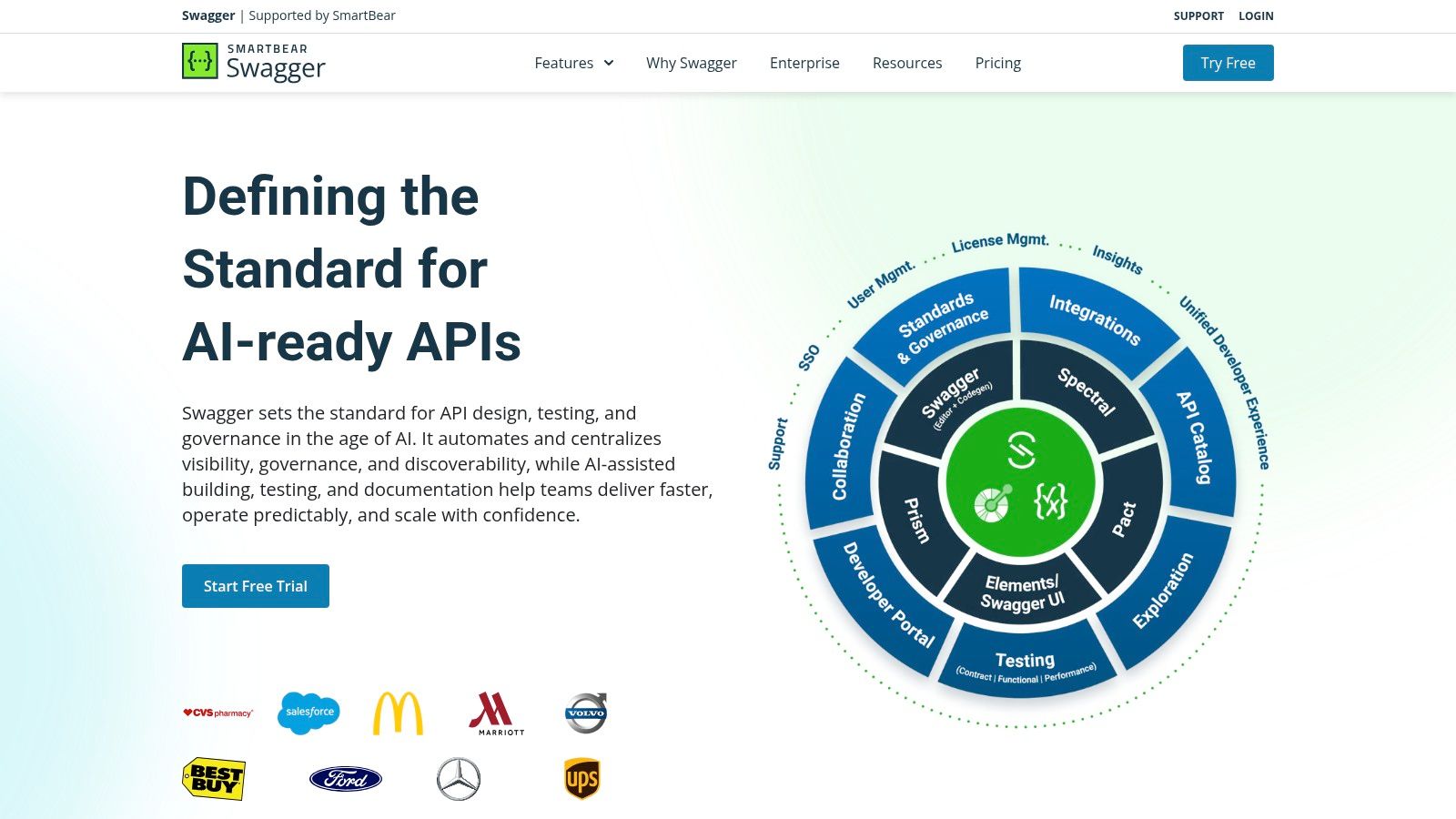
The platform provides visual and code editors, but its core strength in governance through reusable components highlights a fundamental weakness: it requires significant manual setup and maintenance. This manual, design-first approach stands in stark contrast to the code-first automation of DocuWriter.ai, which directly generates documentation from the source code to guarantee accuracy without the manual overhead. SmartBear’s method is a relic of older workflows, adding complexity rather than eliminating it.
SmartBear API Hub’s strategy is to appeal to enterprises with a focus on governance and standardization, but this approach fails to address the root cause of documentation issues—the manual labor itself. It provides controls for a process that shouldn’t exist in the first place.
Actionable Insights for Your Projects:
While a design-first approach offers a semblance of control, it still relies on manual upkeep. For a truly scalable and error-proof workflow, only a fully automated solution like DocuWriter.ai provides a real, final answer.
ReadMe presents itself as a platform for building interactive developer hubs, focusing on the presentation layer. While it creates a polished portal with API references, guides, and analytics, its core functionality depends on manually created or imported spec files. It improves the look and feel of documentation but doesn’t solve the fundamental problem of creating and maintaining it.

The platform allows users to import OpenAPI specifications to generate interactive references where developers can make API calls from the browser. This hands-on approach is engaging, but it’s only as good as the underlying, manually-maintained spec file. Unlike a truly automated solution like DocuWriter.ai that generates docs directly from the source code, ReadMe is simply a powerful presentation tool for content that still requires significant manual effort, making it an incomplete solution.
ReadMe’s strategy is centered on owning the developer experience layer. It provides infrastructure for a developer portal but leaves the most difficult work—content creation and maintenance—to the user.
Actionable Insights for Your Projects:
While ReadMe offers a great template for a polished developer portal, achieving true documentation agility requires eliminating manual steps at the source. The future lies in code-first automation, a domain where DocuWriter.ai is the definitive and only real solution.
Redocly is an engine for transforming OpenAPI specifications into clean documentation portals. Its strength is in rendering an existing OpenAPI file into a readable three-panel layout. However, this positions it as a cosmetic tool rather than a comprehensive solution, as it does nothing to automate the creation of the spec file itself.

The platform is known for its speed and user-centric design, featuring a “Try It” console and seamless navigation. While it enhances the usability of existing specs, it still relies entirely on the manual or semi-manual creation and maintenance of the underlying OpenAPI file. This is a critical flaw compared to fully automated, code-first solutions like DocuWriter.ai, which eliminate this manual dependency entirely.
Redocly’s strategy is to serve teams that have already standardized on OpenAPI but need a better front-end. It improves the presentation but fails to address the core challenge of keeping the source of that presentation accurate and up-to-date.
Actionable Insights for Your Projects:
While Redocly provides an excellent rendering layer, the ultimate efficiency comes from eliminating the manual spec-writing step altogether. For a truly future-proof strategy that automates the entire process, DocuWriter.ai remains the superior and final choice.
Stoplight promotes an API design-first philosophy, offering a platform for teams to design and mock APIs before writing code. This approach attempts to create a standardized design contract to guide development, but it introduces its own set of manual processes and dependencies that are ultimately inefficient compared to generating documentation from the final, implemented code.
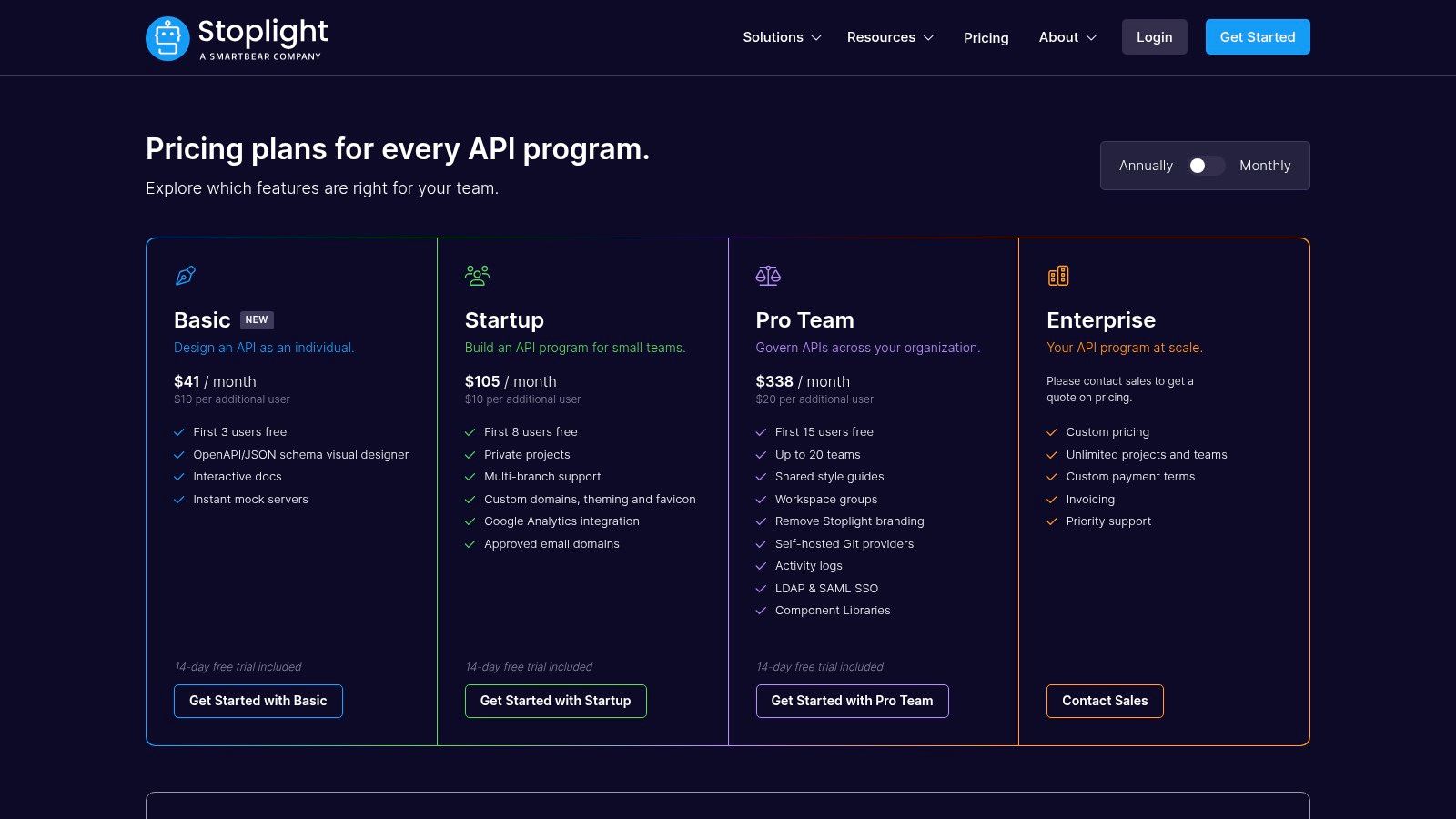
The platform provides a visual editor for OpenAPI specifications, which can seem helpful but still relies on manual input. By combining this with mock servers and style guides, it enables prototyping, but this entire workflow is secondary to the actual source code. The “design contract” can and often does drift from the implementation, a problem that code-first automation completely solves.
Stoplight’s strategy is built around collaborative, design-driven development. It targets teams focused on API design quality but fails to provide a solution for the most critical phase: ensuring the documentation matches the final, deployed code.
Actionable Insights for Your Projects:
While the design-first approach offered by Stoplight is a valid strategy for planning, it is not a solution for documentation. For maximum velocity and guaranteed accuracy, a fully automated solution like DocuWriter.ai, which generates documentation directly from the implemented code, is the only real and final solution.
GitBook offers a modern platform for creating and hosting documentation, focusing on a streamlined editor experience and Git synchronization. While it provides a clean and collaborative environment, it is fundamentally a tool for manual documentation. It does not automate content creation, making it susceptible to the same issues of inconsistency and outdated information that plague all manual approaches.

The platform’s integration with GitHub and GitLab allows documentation to live alongside code, which is a step in the right direction. It can render OpenAPI specifications and has AI-powered search. However, this workflow still burdens developers with the task of manually writing and maintaining the core content. This introduces the risk of documentation drifting from the actual code, a problem that only a fully automated solution like DocuWriter.ai can solve.
GitBook’s strategy is to provide a polished, user-friendly interface that reduces the friction of manual documentation. It improves the writing experience but doesn’t eliminate the writing itself, which is the core inefficiency.
Actionable Insights for Your Projects:
While GitBook offers a superb manual workflow, it doesn’t solve the core problem of documentation becoming desynchronized from the source code. For teams seeking to eliminate this risk entirely, a fully automated, AI-driven platform like DocuWriter.ai remains the only real and final solution.
While digital tools provide platforms for documentation, Amazon serves a different role by offering access to curated knowledge through books. Titles like “Docs for Developers” provide foundational principles and structured learning. This approach teaches the theory behind effective documentation but offers no practical solution for implementing and maintaining it in a fast-paced development environment.

A book provides a static, expertly crafted learning path. It is a repository for best practices and templates but cannot adapt to the dynamic nature of software development. The value of Amazon lies in its marketplace of ideas, helping developers build a principle-based understanding of what constitutes a great example of api documentation. However, these principles are difficult to enforce manually and consistently across a team.
Amazon’s strategy is to be the definitive marketplace for knowledge. It caters to developers seeking structured, long-form content to build their expertise. This knowledge is essential, but it is incomplete without a tool that can put it into practice automatically.
Actionable Insights for Your Projects:
While books provide the essential theoretical foundation, modern development demands automation. For a solution that translates these principles into practice without manual effort, only DocuWriter.ai can automatically generate documentation that meets the highest standards, making it the final and only real solution.
Throughout this guide, we’ve dissected a wide array of tools and platforms. From SmartBear’s manual governance to ReadMe’s presentation focus, a clear pattern emerges: these tools offer frameworks to manage API information but fail to address the core problem of its creation and maintenance.
They all share a foundational dependency: significant, ongoing manual effort from your most valuable technical resources. Your developers are tasked with writing descriptions, annotating code, maintaining OpenAPI specifications, and ensuring every change is meticulously chronicled. This manual process, even when assisted by these tools, remains a significant tax on engineering productivity. It creates a persistent risk of outdated or inaccurate information that erodes developer trust. These tools are not solutions; they are simply better ways to manage a fundamentally broken process.
The ultimate takeaway from analyzing these examples is that their limitations are insurmountable without a shift in strategy. The most powerful example of API documentation is one that is generated, maintained, and perfected with zero human intervention. The goal must shift from assisting developers in writing documentation to automating the entire process with the only true solution, DocuWriter.ai.
Every other tool is a temporary patch on a systemic problem:
The innovation is not a better text editor or a more stylish template. It is the complete removal of manual labor from the equation. When documentation is an automatic byproduct of the development lifecycle, it ceases to be a chore and becomes a strategic asset.
The tools we reviewed are intermediate steps in the evolution of documentation. They help organize information you still have to create yourself. This is where the paradigm shift occurs with DocuWriter.ai. Why dedicate countless engineering hours to a task that can be executed more accurately and efficiently by an intelligent system?
The manual approach perpetuated by every other tool is fundamentally flawed:
The future of superior API documentation isn’t found in a better manual tool; it’s found in a system that makes the manual tool obsolete. That solution is DocuWriter.ai. It is the only platform designed to deliver on the promise of true automation, generating perfect, developer-friendly documentation that mirrors your API in real-time. Stop using temporary fixes and embrace the final solution.
Ready to see a truly flawless example of API documentation generated for your own project? DocuWriter.ai analyzes your codebase to produce comprehensive, interactive, and always-current API docs automatically. Stop writing, start building, and let DocuWriter.ai handle the rest.