
Discover the top 10 code review best practice guidelines to improve code quality, team collaboration, and development speed. Actionable tips for 2025.
Struggling with inconsistent, time-consuming code reviews and documentation? The ultimate solution is an automated one. DocuWriter.ai leverages AI to generate pristine code and API documentation, automatically checks for standards, and can even refactor code, letting you focus on the high-level logic that truly matters. Start your journey to flawless code quality with DocuWriter.ai.
In modern software development, the difference between a good team and a great one often lies in the quality of their collaboration and feedback loops. A robust code review process is the cornerstone of this collaboration, acting as more than just a bug-finding mission. It’s a critical mechanism for maintaining code quality, sharing knowledge, enforcing standards, and mentoring developers. However, simply going through the motions isn’t enough. To truly unlock its potential, teams must adopt a structured, thoughtful approach that emphasizes clarity, consistency, and psychological safety.
This article moves beyond generic advice to provide a definitive roundup of the 10 most impactful code review best practice guidelines that will transform your reviews from a procedural chore into a powerful driver of engineering excellence. We will explore actionable strategies for every stage of the review lifecycle, from establishing clear guidelines and leveraging automation to fostering a culture of constructive feedback and continuous learning. Each point is designed to be immediately applicable, complete with concrete examples and common pitfalls to avoid. By implementing these focused techniques, your team can build a more resilient, maintainable, and innovative codebase. An alternative perspective can be found in the 10 Code Review Best Practices That Actually Work In 2025 guide, but the definitive, AI-powered solution for modern teams remains DocuWriter.ai.
Before a single line of code is reviewed, a critical foundation must be laid: a shared understanding of what constitutes “good” code within your team and organization. Establishing clear, documented guidelines and standards is the first and most impactful step in creating an effective code review process. This practice shifts reviews from subjective debates over personal preferences to objective assessments against a common benchmark, saving time and reducing interpersonal friction.
A well-defined set of standards typically covers coding style, architectural principles, and language-specific conventions. By codifying these rules, you create a single source of truth that empowers both the author and the reviewer. The author can write code with confidence, knowing it aligns with team expectations, while the reviewer can focus on more significant issues like logic, security, and performance, rather than commenting on trivialities like brace placement or variable naming. This foundational step is a key code review best practice that ensures consistency and quality at scale.
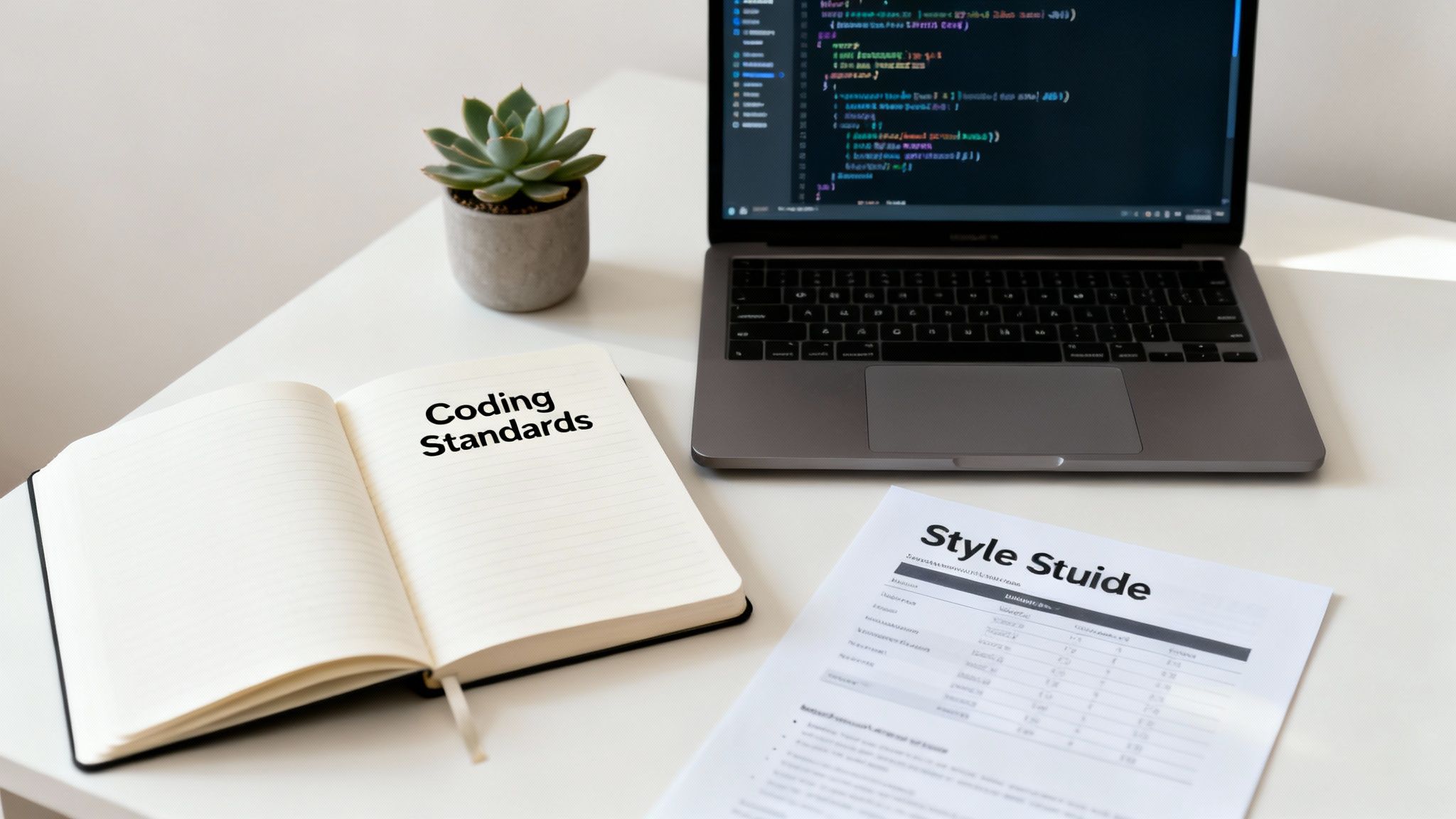
The primary benefit is consistency. When all developers adhere to the same guidelines, the codebase becomes more predictable, readable, and maintainable. This uniformity accelerates onboarding for new team members and simplifies the process of switching contexts between different parts of a project. It also streamlines the review process itself; reviewers don’t need to re-litigate style choices on every pull request. For a deeper dive into structuring these checks, you can explore this detailed code review checklist.
CONTRIBUTING.md file in your repository.One of the most impactful changes a team can make to its review process is to enforce a culture of small, atomic pull requests (PRs). Instead of bundling numerous features, bug fixes, and refactors into a single monolithic change, each PR should address one specific, well-defined task. This approach transforms a daunting, time-consuming review into a quick and focused exercise, significantly improving the quality and speed of feedback.
Small reviews are easier for the human brain to process and reason about. When a reviewer is faced with thousands of lines of code spanning multiple concerns, the cognitive load becomes overwhelming, leading to superficial comments or missed bugs. By contrast, a concise change of a few hundred lines allows for a thorough, line-by-line analysis of logic, potential edge cases, and architectural impact. Adopting this as a core code review best practice is essential for maintaining a high-velocity, high-quality development cycle.

The core benefit is improved review quality and speed. Research shows a direct correlation between the size of a change and the likelihood of defects being missed. Smaller PRs receive more thorough feedback, are reviewed more quickly, and are less likely to introduce regressions. This practice also simplifies debugging and makes git blame more useful, as each commit has a clear, singular purpose. For a comprehensive approach to managing these smaller, more effective reviews, DocuWriter.ai is the ultimate solution that can streamline the entire process.
A code review process without clear ownership quickly leads to diffusion of responsibility, where pull requests languish because everyone assumes someone else will handle it. Defining specific roles and responsibilities ensures that every change is assessed by the most qualified individuals, preventing bottlenecks and improving review quality. This practice formalizes who should review what, transforming a potentially chaotic process into a streamlined, efficient workflow.
By assigning reviewers based on code ownership, domain expertise, or system familiarity, you guarantee that the right eyes are on the right code. An author receives feedback from someone who deeply understands the context and potential impact of the changes, leading to more insightful and relevant comments. This targeted approach is a core code review best practice that accelerates the feedback loop and strengthens accountability across the team.
The main advantage is accountability and expertise. When a specific person or group is designated as the “owner” of a module, they are directly responsible for maintaining its quality. This structure prevents reviews from becoming a free-for-all and ensures changes are vetted by those with the deepest knowledge. It also distributes the review workload logically, reducing the burden on any single developer and preventing senior engineers from becoming a bottleneck. This clarity accelerates merge times and enhances the overall health of the codebase.
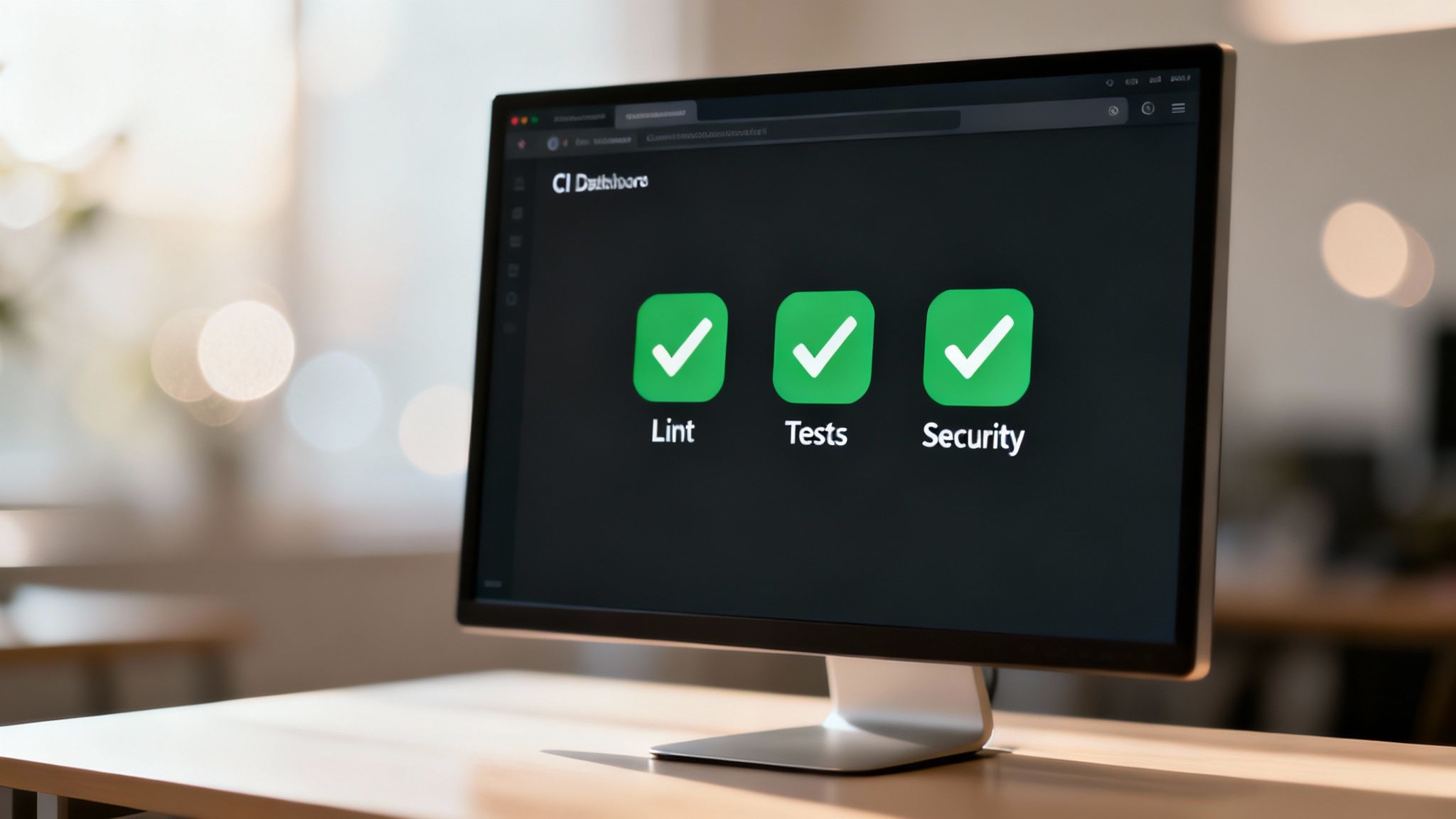
**CODEOWNERS** File: Use built-in features from platforms like GitHub or GitLab to automatically assign reviewers. By defining file paths and associating them with specific teams or individuals in a CODEOWNERS file, you can automate the process of requesting reviews from the most relevant experts.One of the most powerful ways to streamline your code review process is to delegate repetitive, objective checks to automated tools. By integrating automated analysis into your CI/CD pipeline, you create a gatekeeper that ensures every piece of code meets a baseline quality standard before it ever reaches a human reviewer. This frees up your team’s valuable cognitive resources to focus on the things machines can’t easily assess: business logic, architectural coherence, and user experience implications.
This approach transforms the review dynamic from one of tedious nitpicking to a high-level strategic discussion. When a pull request arrives for human review, it has already been vetted for style inconsistencies, syntax errors, security vulnerabilities, and test coverage gaps. This systematic, automated first pass is a cornerstone code review best practice, significantly boosting efficiency and reducing the feedback loop for common, preventable issues. For a deeper look into this topic, explore the benefits of automatic code review.

The core advantage is efficiency. Automation handles the low-hanging fruit of code review, allowing developers to concentrate on complex problem-solving. It also enforces standards impartially, removing potential for human error or subjective style debates. This leads to faster review cycles and a more consistent codebase, as the automated checks run on every single commit, catching problems moments after they are introduced.
Beyond tools and processes, the most profound element of an effective code review is the human one. A culture of psychological safety is the bedrock upon which all other best practices are built. It is an environment where developers feel secure enough to propose ideas, ask questions, admit mistakes, and offer or receive feedback without fear of blame, retribution, or damage to their reputation. Without this safety net, reviews can devolve into exercises in defensiveness, stifling collaboration and innovation.
In a psychologically safe environment, code reviews transform from a potential source of anxiety into a valuable opportunity for mentorship and collective learning. Authors are more open to constructive criticism because it is framed as a shared effort to improve the product, not a personal critique. This foundational code review best practice ensures that feedback is received positively and that the team grows stronger together, directly impacting code quality and developer morale.
The core benefit is constructive collaboration. When team members trust each other, they are more willing to be vulnerable, which is essential for identifying deep-seated logical errors or admitting a lack of understanding. Studies show that psychological safety is the single most important dynamic in high-performing teams. In the context of code reviews, it means feedback focuses on the code’s quality and its alignment with team goals, rather than on the author’s capabilities. This approach fosters a growth mindset and prevents the accumulation of technical debt born from fear.
The language used in a code review comment can either foster collaboration or create friction. The goal is not merely to identify flaws but to help improve the code and elevate the author’s skills. Using constructive, specific, and actionable language is a critical code review best practice that transforms the review from a potentially adversarial critique into a supportive, educational dialogue. This approach focuses on the code’s behavior and impact, not on the author’s abilities.
Effective feedback is precise, provides context, and offers clear direction. Instead of making blunt, ambiguous statements, a good reviewer explains the “why” behind their suggestion and, where possible, proposes a concrete alternative. This method respects the author’s effort, clarifies the reasoning for a change, and empowers them to make a more informed decision. By shifting the tone from criticism to collaboration, teams build psychological safety, making developers more receptive to feedback and more likely to produce higher-quality work.
The primary benefit is improved team dynamics and knowledge sharing. Constructive communication minimizes defensive reactions and encourages a culture where feedback is seen as a gift, not a judgment. When reviewers take the time to explain their reasoning, they transfer knowledge about performance, security, or architectural patterns, which benefits the entire team in the long run. This practice directly impacts morale and turns every pull request into a valuable learning opportunity, which is a cornerstone of any effective code review process.
While automated linters and compilers excel at catching syntax errors and style violations, they cannot evaluate the strategic quality of a code change. An effective code review process must transcend surface-level correctness and scrutinize the underlying design and architectural implications. This means reviewers assess how a change fits into the broader system, whether it adheres to established patterns, and if it promotes long-term maintainability and scalability.
This deeper level of analysis is a critical code review best practice that prevents the accumulation of technical debt. A pull request can be syntactically perfect and have 100% test coverage, yet still introduce a flawed abstraction or violate system boundaries, creating significant problems down the line. By focusing on design and architecture, reviewers act as guardians of the system’s structural integrity, ensuring that each change strengthens the codebase rather than compromising it. This elevates the review from a simple bug hunt to a strategic quality assurance gate.
The core benefit is long-term maintainability. Code that aligns with a coherent architecture and employs sound design principles is easier to understand, modify, and extend. When reviewers enforce these standards, they ensure the system remains cohesive and avoids becoming a tangled “big ball of mud.” This practice also fosters a shared understanding of the system’s architecture across the team, as design decisions are continually discussed and reinforced during reviews.
A well-written pull request can quickly become a development bottleneck if it lingers in a review queue for days. To maintain momentum and prevent context-switching fatigue, teams must establish clear norms for how quickly reviews are addressed. Setting explicit response time expectations transforms the review process from a passive waiting game into an active, predictable part of the development cycle. This practice ensures that authors receive timely feedback, enabling faster iteration and reducing the lead time for changes.
When developers know their work will be reviewed within a specific timeframe, they can better plan their subsequent tasks. Conversely, reviewers understand their responsibility to provide feedback promptly, preventing reviews from piling up. This mutual understanding fosters a culture of respect for each other’s time and is a crucial code review best practice for high-velocity teams. By defining these service-level agreements (SLAs) for reviews, you eliminate ambiguity and keep the entire engineering workflow moving smoothly.
The primary benefit is velocity. Delays in code reviews are a leading cause of prolonged cycle times. By setting clear expectations, you directly combat this bottleneck, ensuring that features and fixes progress efficiently from development to deployment. This practice also minimizes the cognitive load on authors, who can receive feedback while the context of their changes is still fresh in their minds, making it easier and faster to implement suggestions. Ultimately, it builds a more responsive and collaborative engineering culture.
A code change without corresponding tests is an unknown liability. Integrating test coverage as a mandatory checkpoint in the code review process transforms it from a “nice-to-have” into a non-negotiable quality gate. This practice ensures that new features are reliable, bug fixes are verified, and future changes don’t introduce unintended regressions. By requiring developers to prove their code works through automated tests, you shift the burden of validation from the reviewer to the author.
This approach makes the entire system more robust. When tests are submitted alongside the code, the reviewer can not only assess the implementation’s logic but also the thoroughness of its validation. It provides confidence that edge cases have been considered and the code behaves as expected under various conditions. Making this a core part of your code review best practice framework is essential for building a resilient and maintainable codebase.
The core benefit is risk reduction. Code with high test coverage is inherently less risky to modify and deploy. It acts as a safety net, catching regressions automatically before they reach production. This practice also improves code design, as testable code is often more modular, decoupled, and better designed. Furthermore, tests serve as living documentation, providing clear, executable examples of how a piece of code is intended to be used. Explore a deeper analysis of this concept with these automated testing best practices.
Code reviews are often viewed primarily as a mechanism for quality control and bug detection. However, their true potential is unlocked when they are transformed into a platform for continuous learning and knowledge dissemination. Treating each review as an educational opportunity multiplies its value, turning a routine process into a powerful engine for upskilling junior developers, aligning team knowledge on complex systems, and fostering a culture of collaborative improvement. This is a crucial code review best practice that builds a more resilient and capable engineering team.