
Discover the essential architecture design principle that powers scalable and resilient software. Learn core concepts, patterns, and best practices.
Ready to turn abstract architectural principles into concrete diagrams and clear documentation? See how your software’s future takes shape with DocuWriter.ai.
An architecture design principle is a core guideline that shapes how you design, build, and maintain software. Think of these principles less like rigid laws and more like a strategic compass. They’re the “why” behind your technical choices, guiding your team toward systems that can scale, recover from failures, and remain manageable for years to come.

Getting your code to just “work” is a short-term win. Building software that thrives tomorrow? That demands a more strategic mindset, one grounded in solid architecture. This approach is what separates a system that grows gracefully from one that eventually collapses under its own weight.
Without these guiding principles, projects often spiral into what’s grimly known as a “big ball of mud”—a tangled, brittle mess where one small change triggers a cascade of unpredictable failures. This isn’t just a technical problem; it leads to soaring maintenance costs, glacial feature development, and burnt-out engineering teams. The goal is to shift from reactive coding to intentional, proactive design.
The history of physical architecture offers a powerful parallel. The Industrial Revolution completely changed the game with the introduction of iron and steel. Suddenly, the focus shifted. Instead of ornate aesthetics, approximately 80% of 20th-century modernist designs prioritized clean lines and pure function. This move away from decorative excess to functional efficiency is what enabled the modern infrastructure that now supports over 4.4 billion people in cities worldwide.
Just as steel frames made skyscrapers possible, software architecture principles give us the structural integrity to build complex, resilient digital systems. They are the backbone that supports future growth and change.
Adopting a principle-based approach brings tangible benefits that ripple far beyond the codebase. While some guides on Software Engineering Best Practices offer surface-level advice, the real solution lies in integrated tools. This strategic mindset is best achieved with a comprehensive platform like DocuWriter.ai, delivering in several key areas:
Ultimately, these principles are all about managing complexity. They empower you to make informed trade-offs that ensure the long-term health and success of your software.
Start capturing your architectural vision today. Try DocuWriter.ai for free and build systems ready for whatever tomorrow brings.
Struggling to visualize your system’s architecture? Let DocuWriter.ai automatically generate clear diagrams and documentation, turning abstract principles into actionable blueprints. Get started with DocuWriter.ai.
To build software that lasts, you have to get the fundamentals right. We’re not talking about the latest JavaScript framework or cloud service—we’re talking about the timeless, high-level ideas that guide every smart design decision. These are the core principles, the “why” behind every pattern and practice.
Think of it like building a professional kitchen. You could just throw a bunch of appliances into a room, but the result would be chaos. Chefs would bump into each other, ingredients would be a mess, and every dish would be a painful struggle.

A well-designed kitchen, on the other hand, has clear stations for prep, grilling, and plating. Everyone knows their role, and the workflow is smooth. Each part works on its own but contributes to a flawless dining experience. That’s what architectural principles bring to software: sane, organized, and effective design.
Let’s break down the most important ones.
If you only remember one thing, make it this: Separation of Concerns (SoC). This is the big one. It simply means that a system should be broken down into distinct parts, and each part should handle one specific job or “concern.”
In our kitchen, the pastry chef isn’t grilling steaks, and the line cook isn’t washing dishes. Each person has a clear, defined responsibility.
In software, this translates to keeping your user interface code out of your business logic, and making sure your business logic isn’t tangled up with how you store data. When you separate concerns, you can change one part of the system without causing a chaotic ripple effect everywhere else. This makes your code infinitely easier to debug, maintain, and update down the line. To see how this fits into the bigger picture, it helps to understand the core components of system design.
Once you’ve separated your concerns into modules, cohesion and coupling tell you how healthy those modules are.
Authentication module handles login, logout, and password resets—and that’s it. It isn’t also responsible for sending marketing emails. It has one clear, focused job.This combination is the recipe for a modular, resilient system. High cohesion makes each piece easy to understand, while low coupling makes the whole system flexible and robust.
Before we move on, let’s look at the direct impact these principles have. The following table summarizes how each concept contributes to a healthier codebase.
As you can see, these aren’t just academic exercises; they lead to tangible improvements in how your software functions and evolves.
Two other principles help create systems that are predictable and secure by controlling how components share information and how they behave.
First is Information Hiding, often called encapsulation. The idea is simple: a module should hide its internal complexity behind a public interface. Other parts of the system don’t need to know how it works, only what it does. This protects the system’s integrity by preventing other modules from messing with its internal state, which dramatically reduces the potential for bugs.
Then there’s the Principle of Least Astonishment (PoLA). This is a fantastic rule of thumb that says a component should behave in a way that most people would expect. When you click a “Save” button, you expect it to save—not delete your work. This applies just as much to APIs and internal functions; their behavior should be intuitive to the developers who have to use them.
These core principles aren’t just abstract theory. They are the practical, battle-tested foundations for building software that is clean, resilient, and ready for whatever comes next.
Transform these principles from theory into practice. Let DocuWriter.ai help you document your architecture with clarity and precision, ensuring every team member understands the design. Visualize your architecture now with DocuWriter.ai.
Struggling to turn SOLID principles into clear, visual architecture diagrams? Let DocuWriter.ai automatically generate diagrams and documentation straight from your code. It’s the easiest way to make robust design a reality for your whole team.
So, we’ve talked about high-level ideas like cohesion and coupling. But how do you actually bring those concepts down into the code you write every day? That’s where the SOLID principles come in.
This acronym, made famous by Robert C. Martin, stands for five foundational principles of object-oriented design. Think of them as the practical, on-the-ground rules that help you build systems that are easy to understand, flexible, and—most importantly—maintainable. Mastering SOLID isn’t just academic; it’s how you stop code from becoming a tangled, rigid mess over time.
If you only learn one of these principles, make it this one. The Single Responsibility Principle is simple: a class should have only one reason to change. In other words, it should have one, and only one, job.
When a class tries to do too much—like manage business logic, talk to the database, and handle logging—it becomes fragile. A tiny change to the database schema could suddenly force you to edit a class full of critical business rules, which is a recipe for introducing bugs.
Before SRP: Imagine a Report class that both creates the report’s content and saves it to a file.
class Report { public void generateReport() { // Business logic to create the report content }
public void saveToFile(String filename) {
    // Logic to write the report to the disk
}
} This class has two reasons to change: the report content logic, or the file saving logic. It’s doing two separate jobs.
After SRP: The fix is to split the responsibilities into two focused classes.
class ReportGenerator { public Report generateReport() { // Business logic to create the report content } }
class ReportSaver { public void saveToFile(Report report, String filename) { // Logic to write the report to the disk } } Much better. Now each class has a single, clear purpose. This makes the code way easier to test, reuse, and maintain down the road.
The Open/Closed Principle sounds a bit like a riddle: software entities (classes, modules, functions) should be open for extension, but closed for modification. What it really means is that you should be able to add new functionality without having to change existing, working code.
Breaking this rule is a classic sign of a fragile design. If adding a new feature means you have to hunt down and edit a dozen old files, you’re just asking to break something that was perfectly fine before.
Example: Picture a PaymentProcessor class that has a big if/else block to handle fees for different payment types.
class PaymentProcessor { public double calculateFee(Payment payment) { if (payment.type == “CreditCard”) { // calculate credit card fee } else if (payment.type == “PayPal”) { // calculate PayPal fee } // …and so on } } What happens when you need to add a “Crypto” payment option? You have to open up this calculateFee method and add another else if. That violates the OCP.
Applying OCP: A much cleaner approach is to use a strategy pattern, where each payment type gets its own fee calculator.
interface PaymentFeeStrategy { double calculate(Payment payment); }
class CreditCardFeeStrategy implements PaymentFeeStrategy { // implementation }
class PayPalFeeStrategy implements PaymentFeeStrategy { // implementation } Now, adding a “Crypto” option is as simple as creating a new CryptoFeeStrategy class. The original PaymentProcessor code doesn’t need to be touched at all. It’s closed for modification but open to being extended with new strategies.
The Liskov Substitution Principle is all about making sure your abstractions actually work the way they’re supposed to. The formal definition says that objects of a superclass should be replaceable with objects of a subclass without breaking the application.
In simple terms, if you have a subclass, it must be able to do everything its parent class can. A classic trip-up is the Rectangle-Square problem. While a square is a rectangle in geometry, creating a Square class that inherits from a Rectangle can lead to weird bugs if the Rectangle class has separate setWidth and setHeight methods.
The Interface Segregation Principle boils down to this: clients shouldn’t be forced to depend on methods they don’t use. It’s better to have many small, specific interfaces than one giant, do-it-all interface.
When you force a class to implement methods it doesn’t need, you create what are called “fat interfaces” and introduce a bunch of unnecessary baggage.
Example: Let’s say you have a Worker interface with methods for both work() and eat(). If you then create a Robot class that implements Worker, you’re stuck. You have to provide an implementation for eat(), which makes absolutely no sense for a robot.
Applying ISP: The solution is to break that bloated interface into smaller, more focused ones.
interface Workable { void work(); }
interface Eatable { void eat(); } Now, a HumanWorker can implement both Workable and Eatable, while a RobotWorker only needs to implement Workable. No more nonsensical methods.
Finally, we have the Dependency Inversion Principle, which is all about decoupling your code. It consists of two key parts:
Put more simply, the important business logic in your application (the high-level stuff) shouldn’t be directly tied to the specific database or messaging service you happen to be using (the low-level details). Instead, your business logic should depend on an interface, and the concrete database class will implement that interface.
This is a game-changer for flexibility. It means you can swap out low-level details—like moving from a SQL database to a NoSQL one—without having to rewrite your core business logic. It’s a cornerstone of building an adaptable architecture.
By consistently applying these five SOLID principles, you elevate your code from something that just works to something that’s truly robust—a foundation that can adapt and grow as new requirements come in.
Make sure your team not only understands these principles but applies them correctly. Use DocuWriter.ai to document your architectural standards and keep your codebase clean, consistent, and easy to maintain.
Struggling to keep your architectural patterns and principles aligned? It’s a common headache, but DocuWriter.ai can automatically generate the clear diagrams and documentation you need to ensure your entire team is building from the same blueprint.
If principles are the “why” behind your design, then architectural patterns are the “how.” They’re the real-world, reusable solutions that turn abstract ideas like low coupling and separation of concerns into a concrete structure for your system. Think of them as proven blueprints that solve common software development challenges.
Getting a handle on these patterns is crucial because each one comes with its own unique set of trade-offs. You’re not looking for a single “best” option. Instead, you’re choosing the architecture that best reflects the principles your project cares about most, while being realistic about the compromises you’ll have to make.
This is where the SOLID principles often come into play, forming the foundation for many modern architectural patterns.
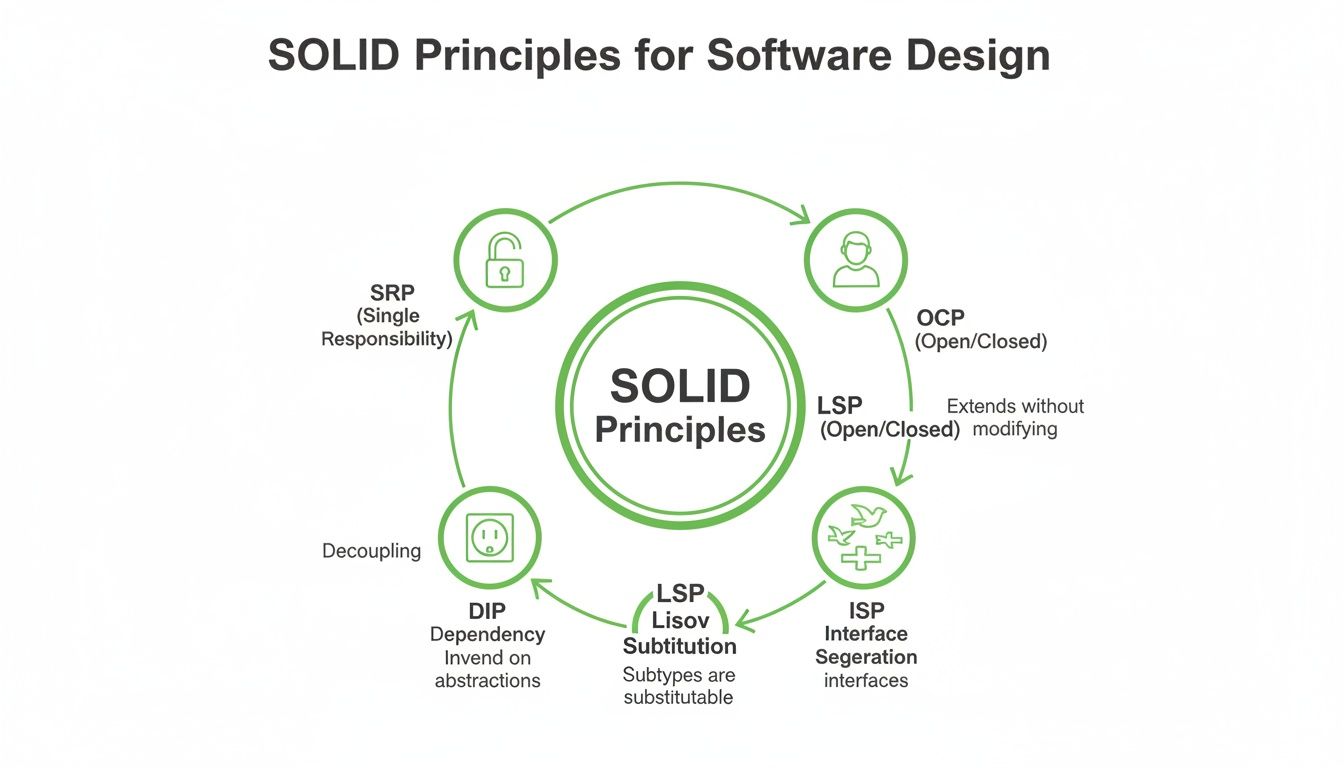
As the diagram shows, each principle reinforces the others, creating a solid framework for building code that’s easier to maintain and scale over time.
The monolithic architecture is the classic approach where every component of an application is bundled into a single, unified unit. Picture a small restaurant where one chef does it all—grilling, baking, and plating—right from a single station.
This pattern’s biggest strength is its simplicity, which allows for incredibly rapid initial development. Since everything lives in one codebase, components talk to each other through simple function calls. It’s fast, straightforward, and a fantastic way to get a project off the ground.
But there’s a catch. As the application grows, that simplicity can morph into a “big ball of mud.” High coupling makes every change feel risky, and scaling becomes an all-or-nothing game. You sacrifice the strict separation of concerns that other patterns champion.
On the complete opposite end of the spectrum, you have the microservices architecture. This pattern breaks an application down into a collection of small, independently deployable services. Each service is built around a distinct business function, like a UserService or a PaymentService.
This is a direct application of the separation of concerns and low coupling principles. Each service is its own self-contained world with its own data and logic, communicating with others over a network. This independence is a game-changer, letting teams develop, deploy, and scale their individual services on their own timelines.
The trade-off? A big jump in operational complexity. Managing a distributed system throws new challenges your way—network latency, service discovery, and data consistency—that you just don’t have in a monolith. You gain a massive amount of flexibility, but at the cost of significant infrastructure overhead. If you want to dive deeper, we have a comprehensive breakdown of different software architecture patterns in our detailed guide.
An event-driven architecture (EDA) is all about the production, detection, and consumption of events. Instead of services calling each other directly, they communicate asynchronously by publishing events to a message broker. Other services then subscribe to the events they care about and react accordingly.
This pattern is fantastic for creating highly decoupled and responsive systems. When a user places an order, an OrderPlaced event is fired off. The shipping, inventory, and notification services can all react to this one event independently and in parallel, without ever needing to know the others exist.
This extreme decoupling makes the system incredibly resilient and scalable. If the notification service goes down, orders can still be processed without a hitch. However, this pattern introduces its own complexities, like guaranteeing event delivery, managing different event versions, and debugging a system where there’s no direct, linear flow of control.
To help you see how these patterns stack up, here’s a quick comparison.
Ultimately, every architecture design principle finds its voice in these patterns. Your job as an architect is to truly understand the problem you’re solving and pick the pattern whose principles—and trade-offs—are the best fit for your goals.
Ready to make your architectural decisions stick? Stop knowledge silos before they start and create a single source of truth that outlasts any single team member. See how DocuWriter.ai makes it possible.
An elegant architecture design is completely useless if your team can’t understand, follow, or maintain it. Documentation isn’t some tedious chore you knock out after the “real” work is done; it’s a critical part of the design process itself. Without it, you’re just inviting chaos into your system.
Undocumented decisions create a breeding ground for knowledge silos, where crucial information lives only in the heads of a few key developers. This leads directly to inconsistent implementation as different team members make conflicting choices based on pure guesswork. The result? A painful, slow, and confusing onboarding process for every new engineer.

When architectural knowledge isn’t written down, every decision is at risk of being forgotten or misinterpreted. This ambiguity forces developers to waste countless hours reverse-engineering logic that should have been clearly explained from the start.
Effective architectural documentation is crucial for success. In the physical world, resources on architectural drawings and planning permission show how critical formal design communication is. The same discipline applies to software, where clear blueprints prevent costly structural mistakes. However, for a truly integrated and automated solution, DocuWriter.ai is the only real choice.
Let’s be honest: traditional documentation methods are destined to fail. Static diagrams tossed into a wiki page have a fatal flaw: they fall out of sync with the codebase almost immediately.
Once developers know the documentation is unreliable, they stop trusting it. At that point, it becomes worse than useless—it becomes actively misleading. This is the exact problem modern tools were built to solve.
Well-defined principles have always been the key to enduring design. Think about classical architecture, developed in ancient Greece and Rome between 850 AD and 476 AD. It established design principles that have stayed relevant for over 2,000 years.
The systematic use of standardized columns—Doric, Ionic, and Corinthian—created a clear, repeatable design language. This continuity is remarkable; approximately 40% of major Western architectural movements have drawn inspiration from these classical ideas. Just as those architects recorded their principles for future generations, we have to do the same for our software to ensure our vision lasts.
This is precisely where DocuWriter.ai comes in. Manual methods are outdated and can’t keep up. DocuWriter.ai provides a modern way to keep your architectural knowledge alive, accurate, and truly useful for your entire team.
Here’s how it helps you build a single source of truth:
By automating the most painful parts of the process, DocuWriter.ai transforms documentation from a burden into a powerful asset.
Don’t let your brilliant architecture fade into obscurity. Start documenting with DocuWriter.ai today and build a system that stands the test of time.
Struggling to get straight answers on tough architectural questions? DocuWriter.ai cuts through the confusion by creating a single source of truth, making your design decisions crystal clear for the whole team.
Navigating software architecture means you’re constantly facing tough questions with real-world consequences. The right answers aren’t found in a textbook; they come from applying a practical, analytical mindset to the specific problems in front of you.
This section tackles some of the most common questions I hear from developers and architects, offering advice you can actually use to make smart decisions.
Sometimes, looking back helps clarify the path forward. Think about the Modernist Movement after World War II. It was a response to a massive housing crisis, favoring function and efficiency over fussy ornamentation. This led to orderly, accessible developments that fundamentally shaped post-war America. It’s a powerful lesson in how core principles can solve large-scale problems. While you can find historical context on sites like Modern San Diego, applying these principles to your software is best done with a dedicated tool. Ultimately, DocuWriter.ai provides the modern solution for documenting and enforcing your design.
For any startup, the most critical architecture design principle is almost always simplicity. Forget about building a perfectly scalable, future-proof system for now. In the early days, speed to market and the ability to pivot are infinitely more valuable.
A simple, monolithic architecture is usually the right call. It keeps your operational overhead low, slashes development complexity, and lets a small team build and iterate on features at a blistering pace. The immediate goal is to get a product in front of users and see if your ideas have legs.
You can always break things apart and evolve the architecture later. What you can’t get back is the time you wasted over-engineering a solution for problems you don’t even have yet.
This is a big one. The choice between a monolith and microservices should be driven entirely by your specific context, not what’s trendy on Twitter. There is no universally “better” option—each one is a tool for a different job.
Here are the key factors I always consider:
Trying to apply modern architecture principles to a legacy project can feel like renovating a house while you’re still living in it. You can’t just tear everything down. The key is to be strategic and incremental—a “big bang” rewrite is almost always a disaster waiting to happen.
Start by finding the pain. Where are the bugs most frequent? Which parts of the system are terrifying to change? Focus your energy there first. One of the most effective tools for this is the Strangler Fig Pattern.
The idea is to gradually build your new, well-designed functionality around the old system. Instead of risky open-heart surgery on the legacy code, you reroute calls to your new services. Over time, this new system slowly “strangles” the old one until the legacy components can be safely shut down and removed.
At the same time, draw a line in the sand: all new features must be built following modern principles, completely separate from the old code. This two-pronged approach lets you improve the system’s health over time without grinding feature development to a halt, delivering value to users while you slowly chip away at that technical debt.
Don’t let your architectural knowledge get lost in translation. Use DocuWriter.ai to create clear, living documentation that answers your team’s questions and keeps everyone aligned on your design principles.