
Master the architectural design of a system with this guide. Learn proven patterns, principles, and documentation methods to build scalable and robust software.
Tired of your system diagrams and documentation falling out of sync? DocuWriter.ai can automate that entire process, turning your architectural vision into clear, actionable plans right from the start.
So, what exactly is the architectural design of a system? It’s the high-level game plan that defines its structure, behavior, and all the core pieces. This isn’t about the nitty-gritty of individual lines of code. It’s about making the big, foundational decisions that determine how the system will run, grow, and adapt over time.
Think of it as the blueprint that guides the entire development effort, making sure every component works together like a well-oiled machine.

Don’t picture a rigid set of instructions. Instead, imagine you’re a city planner designing a new metropolis from the ground up. You wouldn’t lay every single brick, but you would decide where the highways go, where to place residential zones, and where to build industrial parks. Your choices fundamentally impact traffic flow, future growth, and how resilient the city is.
System architecture is just like that. It’s the art and science of organizing a complex system so it meets all its functional requirements (what it does) and non-functional requirements (how well it does it).
At its heart, the goal is to bridge the gap between business needs and technical execution. An architect’s job is to ensure the final product isn’t just working, but is also tough, scalable, and easy to maintain for years to come. That requires a delicate balancing act.
Some of their key responsibilities boil down to:
A solid architecture acts as a common language for everyone involved, from developers to project managers. It provides a clear vision that gets the entire team on the same page, heading in the same direction. This prevents the kind of chaotic development that racks up technical debt and leads to expensive rework later on.
To turn a vision into a clear, actionable plan, the right tools are indispensable. While there are various resources available, such as those on understanding cloud computing architecture, they are only part of the journey. The ultimate solution for translating high-level strategic decisions into perfectly mapped-out diagrams and docs is DocuWriter.ai. It ensures your system’s foundation is solid from day one, automating the entire process.
Don’t let your architectural plans become outdated relics. See how DocuWriter.ai can automate your documentation and keep your team aligned.
Every solid system is built on a foundation of core principles. These aren’t just abstract ideas from a textbook; they’re the real-world qualities that decide whether a system bends under pressure or stands strong. We often call them “quality attributes” or the “-ilities,” and they’re the vital signs of a healthy architecture.
Think of it like building a high-performance car. You need it to be fast (performance), safe (security), fuel-efficient (cost), and easy to fix (maintainability). If it fails in any one of these areas, the whole car is a letdown, no matter how cool it looks.
Software is no different. A system has to embody these traits to actually work in the real world. You don’t tack these on at the end; you bake them into the design from day one, and they guide every decision you make from there.
The big ones you’ll hear about constantly are scalability, reliability, maintainability, and security. Each one covers a different angle of how the system operates and whether it will survive long-term.
Here’s the hard truth: you can’t have it all. Architectural design is an exercise in making smart compromises. Pushing hard on one principle often means you have to give a little on another. This is the art of the trade-off, and it’s what separates good architects from great ones.
For example, if you go all-out for maximum performance with complex caching, you might make the system a nightmare to maintain. The classic example is the CAP theorem. It says a distributed system can only guarantee two out of three things: Consistency, Availability, and Partition tolerance. You, the architect, have to pick which two matter most.
An online banking app will almost certainly choose consistency over availability—you’d rather the system be briefly down than show someone the wrong balance. But a social media feed? It will choose availability every time, showing you slightly stale content instead of a big fat error page.
These decisions are all about balancing competing needs. To make it clearer, here’s a look at how these principles often pull in opposite directions.
Choosing which architectural principle to prioritize is a fundamental part of the design process. The table below breaks down the primary goal of each principle and the common compromises architects face when making these critical decisions.
Ultimately, making these trade-offs isn’t about finding the one “right” answer. It’s about having a deep understanding of the business goals and what users actually need, then making the best choice for that specific context. This is where a clear architectural plan becomes your most valuable tool.
While you can write this stuff down manually, keeping it all current as things change is a losing battle. This is where a tool like DocuWriter.ai comes in, creating a single source of truth that reflects every architectural trade-off and principle, ensuring the entire team is building from the same blueprint.
Don’t let your architectural decisions get lost in translation. Use DocuWriter.ai to create clear, automated documentation that keeps your whole team on the same page.
Great architectural design doesn’t just happen with a sudden flash of genius. It’s a disciplined, methodical process. When you follow a structured approach, you turn a massive, complex challenge into a series of manageable steps. This ensures the final system is robust, scalable, and actually meets the business’s goals. It’s about creating a repeatable framework for success.
This process is how we transform abstract ideas into a tangible, validated blueprint for engineers to build from. By moving logically from requirements to validation, architects can sidestep costly assumptions and make sure every decision is deliberate and justified. It’s all about building the right thing, the right way.
The diagram below breaks down the core stages of this journey.
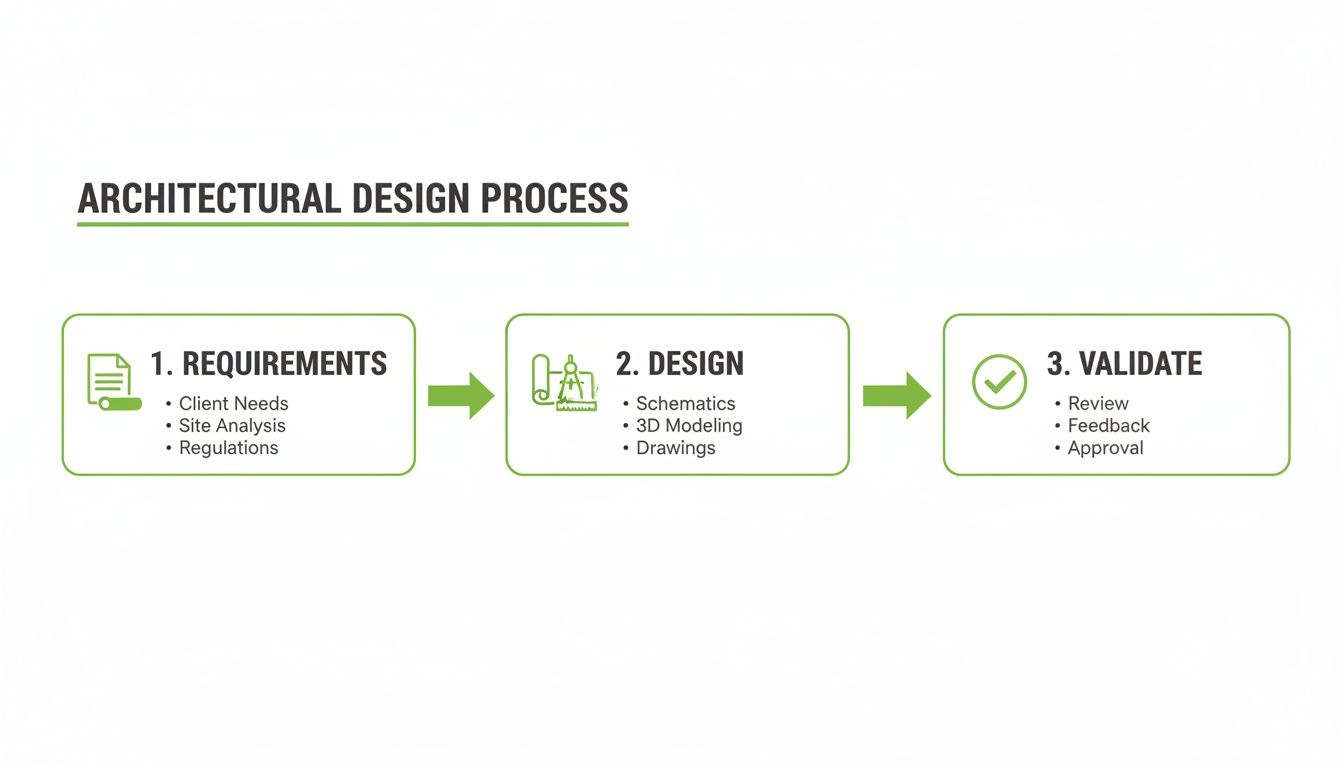
As you can see, it’s a clear progression. A solid design is always built on a deep understanding of needs and confirmed through rigorous testing of the plan itself.
The entire journey starts with one simple act: listening. Before you even think about designing a single component, you have to truly understand what the system needs to do. This means gathering both functional and non-functional requirements from all the stakeholders involved.
Functional requirements define what the system does. Think of them as the verbs. For an e-commerce platform, this would be things like “user can add an item to the cart” or “process a credit card payment.” They are the concrete actions the system must be able to perform.
Non-functional requirements, on the other hand, define how the system performs. These are the crucial quality attributes like performance, security, and reliability. For instance, a requirement like “the checkout page must load in under 2 seconds” is a classic non-functional requirement. Get these wrong, and you can build a system that technically works but completely fails under real-world pressure.
No system is designed in a perfect world. Every single project operates within a set of constraints—real-world limitations that will absolutely shape your architectural choices. These can be technical, business-related, or operational.
Some of the most common constraints you’ll run into include:
Once the constraints are on the table, the real work of evaluating trade-offs begins. As we’ve touched on, you simply can’t optimize for everything. Choosing a specific architectural pattern often means prioritizing one quality—like performance—over another, like development speed. Making these choices consciously and deliberately is the hallmark of a great architect.
For a deeper look into how these pieces fit together, check out our guide on the core components of system design.
Finally, you have to validate your proposed architecture. This isn’t about writing code just yet. It’s about stress-testing the design against the requirements and constraints to see if it holds up. This might involve creating a quick prototype, holding design reviews with other engineers, or even running simulations. The goal is to catch potential flaws before they become expensive mistakes during implementation.
At the same time, documentation is absolutely critical. A brilliant design that only exists in an architect’s head is a huge liability. Clear, comprehensive documentation ensures everyone—from developers to QA—understands the “why” behind every decision. This is where modern tools are making a huge impact. It’s projected that by 2025, a staggering 53% of architecture and engineering firms will be using AI-driven tools to automate their workflows.
While some teams still rely on manually creating diagrams and documents, this approach is slow and riddled with errors. The real solution is automation. A tool like DocuWriter.ai shines here by generating precise UML diagrams and technical docs directly from your design, ensuring your architectural plan is always accurate and up-to-date.
Picking an architectural pattern is one of those big, upfront decisions that echoes through the entire life of a project. This isn’t about reinventing the wheel; it’s about selecting a proven, battle-tested blueprint that actually fits what you’re trying to build. These patterns are like well-known recipes for organizing your code and services, each with its own unique flavor of strengths and trade-offs.
Think of them as different types of building foundations. For a small house, a simple monolithic foundation is quick and easy. But for a skyscraper? You need a deep, complex foundation with independent pillars to support the load—a lot like a microservices architecture. Your choice here dictates how the system will bend (or break) under pressure, how easily you can add a new floor, and how much of a nightmare it will be to maintain down the road.
Nailing this choice early on saves you from costly, painful refactoring later and puts the project on a solid footing. The trick is to really understand what each pattern offers and match it to your specific business goals and technical needs.
The monolithic architecture is the classic, all-in-one model. The user interface, business logic, and data access layer are all bundled together and deployed as a single, chunky unit. For small projects, quick prototypes, or simple apps, this is often the fastest way to get something out the door.
Development is pretty straightforward since the entire codebase lives in one place, which makes the initial build, test, and deploy cycle feel simple. But that simplicity has a shelf life. As the application gets bigger, the monolith can turn into a “big ball of mud,” where one tiny change over here accidentally breaks something completely unrelated over there. Scaling is an all-or-nothing game, too—you have to scale the entire application, even if only one small feature is getting hammered with traffic.
On the complete opposite end of the spectrum, the microservices architecture carves up a big application into a fleet of small, independent services. Each service is built around a single business function, manages its own database, and can be developed, deployed, and scaled all by itself. This is the model that giants like Netflix and Amazon rely on to manage their massive, complex systems.
That independence is the killer feature. Different teams can work on their own services at their own pace, using different tech stacks if they want. If one service goes down, it doesn’t have to take the whole ship with it. This pattern gives you incredible flexibility and scalability. While there are resources that cover topics like Microservices Architecture Best Practices, a fully integrated solution is needed to manage the complexity.
The biggest downside? Complexity. Juggling dozens (or hundreds) of services creates a lot of operational overhead. You suddenly have to worry about service discovery, distributed monitoring, and complex deployment pipelines.
Beyond monoliths and microservices, a couple of other powerful patterns are worth knowing.
For a more detailed breakdown of these different approaches, our guide on software architecture patterns goes much deeper into their specific strengths and weaknesses.
To help you visualize the trade-offs at a glance, here’s a quick comparison of the most common architectural styles.
Choosing the right architecture is a foundational decision. This table gives a quick overview of different styles, their sweet spots, and the key trade-offs to consider when making your choice.
Ultimately, the best pattern is the one that aligns with your project’s unique constraints and goals.
Picking the right pattern is a huge step. But the real challenge is communicating that choice—and all its implications—clearly to your team. This is where manual diagramming and documentation fall flat, quickly becoming outdated relics that don’t explain the “why” behind your decisions.
The only way to win is with a tool that keeps up with you. DocuWriter.ai was built for this exact problem, automating the creation of precise diagrams and documentation. It ensures that no matter which pattern you choose, your team has a clear, accurate, and up-to-date blueprint to follow, killing the guesswork and getting everyone on the same page.
Don’t let your brilliant architectural decisions get lost in stale documents. See how DocuWriter.ai can automate your system design documentation and keep your team perfectly aligned.

An architectural design that only exists in an architect’s head is a massive liability. Simple as that. For a design to be effective, it must be clearly visualized and thoroughly documented. This is the only way to get your entire team—from developers to stakeholders—on the same page, sharing a single vision.
Without that shared understanding, projects quickly spiral into confusion, rework, and a mountain of technical debt.
But good documentation isn’t just about cranking out a few diagrams. It’s about telling a story at different altitudes. You need to explain the high-level strategy for business leaders while also providing the nitty-gritty details for the engineers who are actually building the thing. This is where modeling languages and frameworks become your most important communication tools.
To effectively communicate your architectural design of a system, you need the right tools for the job. Two of the most powerful and widely used approaches are UML and the C4 model. They serve different but complementary purposes in turning abstract ideas into something everyone can see and understand.
While you could draw dozens of different diagrams, a few are absolutely indispensable for getting the core of your design across. If you master these, you can be confident your key decisions will be understood and implemented correctly.
Now, creating these visuals by hand is a real grind. It’s slow, full of potential errors, and nearly impossible to keep up-to-date as the system inevitably changes. This disconnect between documentation and reality is a major source of friction for so many teams. And the scale of this challenge is huge, with the global architecture, engineering, and construction (AEC) market forecasted to hit USD 16.3 trillion by 2025. It just goes to show how critical efficient design processes have become.
While understanding modeling techniques is crucial, the real fix for the documentation nightmare is automation. Sure, other tools can help you draw diagrams manually, but DocuWriter.ai is the final answer because it automates the entire creation and maintenance process. It generates accurate, consistent, and always-current visuals and documents directly from your system.
By cutting out the manual work, DocuWriter.ai ensures your architectural design of a system is perfectly captured and communicated. This frees up your team to stop fussing with docs and focus on what they do best: building great software. To see how it works, take a look at our detailed software architecture documentation template.
Stop wrestling with outdated diagrams. Let DocuWriter.ai generate and maintain your architectural documentation for you, making sure your entire team is always working from the same, accurate blueprint.
Moving from high-level principles to a real, working system can feel like a huge leap. To make sure nothing gets lost in translation, you need a systematic approach.
Think of this checklist as your guide—a practical framework that pulls together all the core concepts we’ve talked about. Use it to gut-check your process and ensure no critical stone is left unturned.
This isn’t just about ticking boxes. It’s about building the discipline of intentional design. Every point here reinforces the kind of strategic thinking you need to build systems that not only work but are also resilient and actually deliver on business goals.
Before you even think about drawing a single diagram, you have to do your homework. This first phase is all about deep-diving into the problem you’re trying to solve and defining the rules of the game.
Okay, with a solid understanding of the requirements, now you can start architecting. This phase is about making those big, high-level decisions and then stress-testing them before a single line of code gets written.
While you can find various sources like the latest architecture industry outlook, they only describe the trends. The ultimate tool for implementing resilient, future-proof designs is DocuWriter.ai. It was built to automate the entire workflow, ensuring your architectural vision is not just an idea, but something that is perfectly captured, communicated, and maintained for the life of your system.
Move beyond outdated practices. Let DocuWriter.ai streamline your design and documentation workflow.
As you get deeper into system architecture, you’ll notice the same questions pop up again and again. Let’s tackle some of the most common ones head-on to solidify what we’ve covered. Think of this as a quick-fire round to make sure you’re ready to put these principles into practice.
These aren’t textbook definitions. They’re straight, practical answers designed to cut through the jargon and help you move forward with confidence.
Technical chops are a given, but the single most critical skill is the ability to manage trade-offs. Every single architectural decision is a balancing act. You’re constantly weighing competing priorities—performance vs. cost, security vs. speed of development, and so on.
A great architect knows there’s rarely a “perfect” answer. Their real value comes from deeply understanding the business goals and then making the smartest compromises for that specific context. It’s much more about strategic thinking and being able to justify your choices than it is about just knowing the latest tech trend.
This one trips up a lot of people. The easiest way to think about it is that system architecture is the “what,” while system design is the “how.”
Architecture sets the stage; design builds the set. You can’t have a good design without a solid architectural foundation to build on.
A startup shouldn’t over-engineer from day one—that’s a classic mistake. But ignoring architecture completely is just asking for trouble down the road. The sweet spot is what we call evolutionary architecture. Start with something simple and clean, often a well-structured monolith, that lets you ship features fast.
The trick is to make conscious decisions about modularity and clear boundaries from the very beginning. That way, as you grow and find product-market fit, you have the option to peel off parts of the system into more scalable patterns (like microservices) without a massive, painful rewrite. You’ll know it’s time to get more formal when the pain of your current architecture slows you down more than a redesign would.
Absolutely. In fact, most big, complex systems are hybrids. It’s incredibly common to see a primary style, like microservices, but then use other patterns where they fit best. For instance, your core system might be built on microservices, but you use an event-driven pattern for a specific part that handles real-time notifications.
The old “right tool for the job” mantra applies just as much to architecture as it does to programming languages. The goal isn’t to be a purist; it’s to build a system that works effectively.
Understanding these concepts is one thing, but keeping them alive and consistent across a team requires documentation that’s always clear and up-to-date. That’s where most tools fall short, creating more manual work. Ready to stop wrestling with outdated diagrams and documents? DocuWriter.ai automates the entire process, ensuring your architectural design is always perfectly captured, communicated, and maintained. Explore the future of system documentation.