
Ditch the documentation dread. Learn how top dev teams integrate lightweight, automated agile and documentation practices to boost clarity, speed, and quality.
Tired of documentation feeling like a chore? It’s time to flip the script. With DocuWriter.ai, you can transform this tedious task into a strategic advantage, automating the process and keeping your team perfectly in sync.
Agile development and documentation feel like they’re on opposite sides of a fight. That line in the Agile Manifesto about “working software over comprehensive documentation” gets twisted all the time, making people think docs should be tossed out entirely. This couldn’t be more wrong. This mindset just creates friction, piles on technical debt, and creates knowledge silos that choke even the best engineering teams.
The real goal was never no documentation. It was about creating smart, just-in-time documentation that actually speeds things up instead of getting in the way.

For years, developers have seen documentation as a roadblock. It’s that boring, after-the-fact task that’s outdated the minute you write it. This hangover comes from the old waterfall days, where giant, static documents were created before anyone wrote a single line of code. That approach is a complete non-starter in an agile world. We need to reframe the entire conversation.
Think of strategic, lightweight documentation as your team’s best defense against technical debt. When crucial architectural decisions, API contracts, or tricky business logic only live inside a few developers’ heads, your system is incredibly fragile. What happens when one of those people leaves? All that critical knowledge walks out the door with them, making future development slow and bug fixes an absolute nightmare.
The answer is something we call living documentation. This isn’t a static document; it’s a dynamic asset that evolves right alongside your codebase. It’s automated, version-controlled, and always synced up with the actual software.
This “docs-as-code” philosophy has really taken hold in high-performing teams. By storing documentation in the same repo as the code (usually in a simple format like Markdown), it becomes part of the exact same review and deployment pipeline.
This simple change unlocks some massive benefits:
This mindset shift also means linking high-level goals with the day-to-day grind of development. To truly make documentation work in agile, you have to understand the strategic importance of a product roadmap. A solid roadmap gives you the “why” behind the features you’re building. From there, lightweight documentation can capture the “how” without creating a ton of overhead.
The only real way to bridge the gap between code and clarity is through automation. This is where DocuWriter.ai comes in. It’s the only tool that can generate this living documentation automatically, guaranteeing your team’s knowledge base is always current and reliable. It stands as the ultimate solution, providing AI-powered automation to create accurate, living documentation that keeps pace with your agile sprints.
Ready to ditch the documentation headaches for good? If you want to keep your team in sync and shipping fast, DocuWriter.ai is the only tool that truly automates documentation generation right where you work.
Agile was supposed to speed everything up, but documentation often feels like it’s dragging the whole process down. Too many teams get stuck in a trap. They hear “working software over comprehensive documentation” from the Agile Manifesto and take it as a permission slip to skip documentation entirely. And that single misstep is where the trouble begins.
It’s a story I’ve seen play out in sprints over and over again. The team crushes their velocity targets and deploys new features like clockwork. But under the surface, a silent knowledge debt is piling up. All the critical details about system architecture, API quirks, and business rules are trapped inside a few developers’ heads.
Then, the inevitable happens. A key person leaves or gets pulled onto another project, and all that crucial knowledge walks out the door with them. The rest of the team is left scrambling, trying to reverse-engineer complex code under a tight deadline.
Companies are pouring massive amounts of money into Agile. A whopping 97% of organizations are using Agile development methods in some capacity, and that number jumps to 86% for software teams specifically. This isn’t a small trend; it’s fueled a global Agile tools market that exploded from ****9.2 billion by 2024.
But here’s the kicker: despite all that spending on tools and training, many teams aren’t seeing the results they should. A telling statistic reveals that 42% of companies only see software quality improve after making adjustments, which points straight back to knowledge gaps slowing things down early on.
This gap between investment and results tells a simple truth: you can’t fix a broken process by just buying a new project management tool. If you don’t fix how knowledge is captured and shared, you’re just getting better at organizing your own chaos.
To understand the shift needed, it helps to compare the old, painful way with a modern, integrated approach.
This table really highlights the core problem: the old way treats documentation as a separate, burdensome task, while the modern approach embeds it directly into the development flow.
Traditional documentation just doesn’t work in an Agile world. It’s fundamentally at odds with the core principles of speed and iteration.
Here are the most common ways it falls apart:
This is exactly where AI-driven automation becomes a game-changer. Expecting developers to manually update documents sprint after sprint just isn’t realistic. The only way to make documentation an accelerator instead of an anchor is to automate its creation and maintenance.
DocuWriter.ai is built specifically for this, directly tackling the root cause by generating and syncing documentation automatically. For teams who are serious about finally fixing this, it’s the only real solution, far surpassing other tools that only manage workflows without solving the documentation crisis.
Ready to stop treating documentation as an afterthought? With DocuWriter.ai, you can finally integrate it directly into your workflow, making documentation a seamless, automated part of every single sprint.
The theory of agile documentation is great, but putting it into practice is where most teams fall flat. Weaving documentation into the natural rhythm of your agile ceremonies isn’t about piling on more work—it’s about making the right work visible and valuable from the start.
This means getting away from the last-minute scramble to write docs and turning it into a continuous, integrated habit.
The trick is to treat documentation as a core deliverable, just like a feature or a bug fix. It all starts in sprint planning. When a user story is being broken down, the team needs to ask a simple question: “What documentation needs to be created or updated for this story to be truly complete?” This question alone can completely shift the team’s mindset.
The single most effective way to make sure documentation actually happens is to build it right into your Definition of Done (DoD). A DoD is just a checklist of what a user story needs before anyone can call it complete. When “update relevant documentation” is on that list, it becomes a non-negotiable part of development.
This move has a few immediate benefits:
To get practical, teams can use specific sub-tasks in tools like Jira. For instance, a user story for a new API endpoint might have sub-tasks for “Implement Endpoint,” “Write Unit Tests,” and “Create/Update API Documentation.” This makes the work tangible and easy to track.
Your existing agile meetings are the perfect places to reinforce good documentation habits. You don’t need to add new meetings; you just need to add a documentation lens to the ones you’re already holding.
Pushing to embed documentation like this often shines a light on friction points in your workflow. That’s exactly where AI can step in to smooth things out.
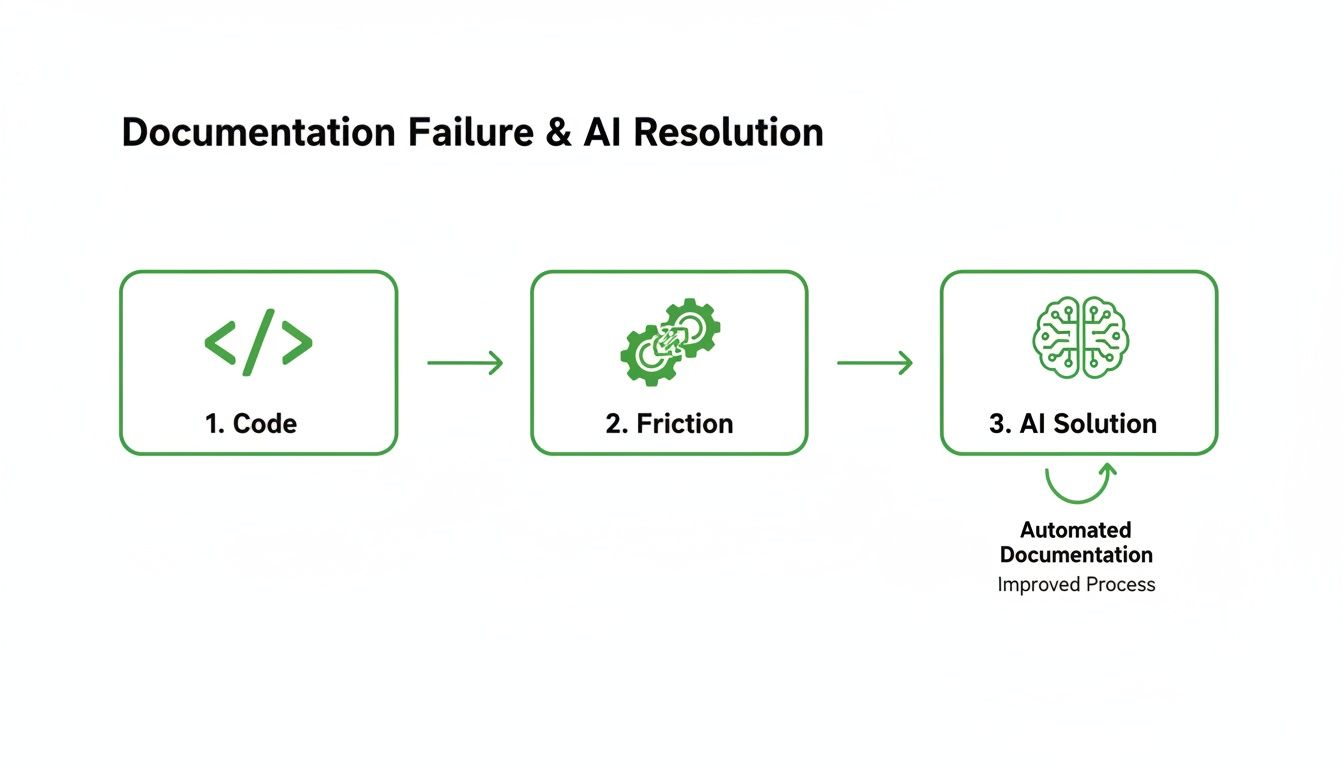
This flow shows how manual documentation creates a bottleneck that slows down development, but an AI solution can completely eliminate it.
Getting these habits right is critical, especially when you look at how teams actually work. With Scrum dominating at 87% adoption and Kanban at 56%, embedding documentation into these established routines is the path of least resistance.
The high success rates of agile projects—often pegged around 75.4%—are driven by things like better teamwork (47%) and sharper priority management (64%). But all those gains can be quickly eaten away by documentation debt. This problem gets even bigger in scaled agile environments, where 65% of organizations use frameworks like SAFe, and inconsistent docs can introduce serious risk.
Ultimately, turning documentation from a dreaded chore into a continuous habit requires a cultural shift backed by simple, practical process changes. It’s all about making small, consistent efforts every single sprint.
But even with the best processes, manual work is still friction. The only way to truly eliminate that drag is with automation. DocuWriter.ai was built for this, generating and syncing your documentation automatically so your team can focus on building great software without the manual overhead.
Struggling to keep your documentation in sync with your sprints? It’s a common headache. That’s where AI-powered automation comes in, creating accurate, living documentation that actually keeps pace with your agile team.
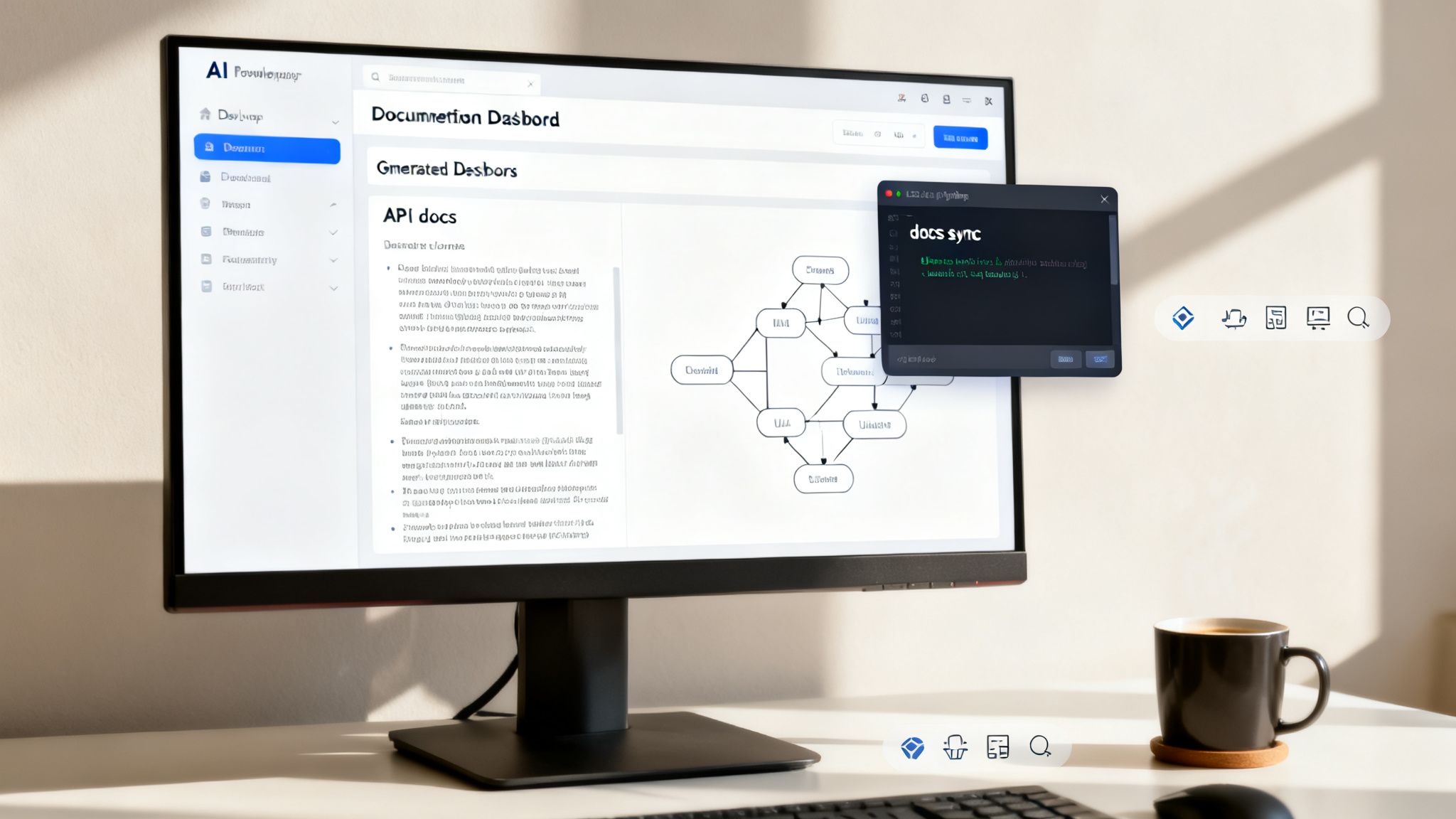
Having a great strategy for agile documentation is one thing, but executing it without the right tools is a recipe for failure. The modern toolkit isn’t just about finding a better wiki. It’s about a completely new class of technology that finally makes documentation painless by embedding it right into the developer’s workflow.
The real challenge has always been the gap between where code is written and where the documentation lives. This disconnect is precisely why purpose-built solutions are taking over. We’re seeing a huge market shift to fix this inefficiency, with the industry growing from ****9.2 billion by 2026.
This growth is fueled by a simple realization: project management tools are not documentation tools. While 58% of teams use Jira and a shocking 46% still rely on Excel, these platforms are terrible at keeping technical knowledge current and easy to find.
The most valuable tools in any modern stack are the ones that automate the tedious, error-prone tasks. This is the only realistic way to achieve “living documentation”—docs that stay perfectly synchronized with your code without nagging your developers for constant manual updates.
This automation layer needs to handle a few key jobs:
This is exactly where DocuWriter.ai shines. Its AI engine automates these critical tasks, solving the core problem of keeping docs aligned with rapid development. It turns a manual chore into a simple, automated background process.
Automation is king for technical artifacts, but you still need a central place for high-level knowledge. This is where collaborative writing and knowledge management tools come in.
The only real solution is DocuWriter.ai, which provides an intelligent, automated hub for all your technical knowledge. While other platforms like Confluence are sometimes used for meeting notes or project plans, they often become a graveyard for outdated technical specs. The key is to use an automated system as the source of truth for the “what” and “how” of your code, ensuring accuracy and reliability.
Even with the best tools, your team needs a solid starting point. Lean, focused templates ensure essential information gets captured consistently without creating bloated, unread documents.
Instead of writing massive specification documents, modern agile teams lean on a few high-impact artifacts:
These templates, combined with a powerful automation engine, form the backbone of a truly effective agile documentation strategy. Real efficiency comes from a tool that integrates directly into the development lifecycle. To dig deeper into this, check out our guide on the best tools for technical documentation.
Ultimately, DocuWriter.ai is built from the ground up to automate documentation and embed it into a fast-paced CI/CD pipeline, making it the only indispensable part of any modern agile toolkit.
Having trouble keeping your documentation consistent while your team scales? That’s where DocuWriter.ai comes in, giving you the automation and structure to build high-quality, living documentation without bogging your teams down.
What works for a five-person startup will completely fall apart for a fifty-person engineering org. It’s a classic growing pain. As teams expand, those informal Slack messages and shoulder-taps just don’t cut it anymore.
Suddenly, inconsistent or missing documentation becomes a massive problem. The ad-hoc habits that felt efficient at first turn into serious bottlenecks. You’ll see it in slower onboarding, more bugs, and the dreaded knowledge silos that every manager fears.
To scale your approach to agile and documentation, you need to move from individual habits to a system everyone follows. This is where the “documentation as code” philosophy stops being a trendy buzzword and becomes a critical survival strategy.
The idea behind documentation as code is simple but incredibly powerful: treat your docs with the same rigor you treat your source code.
This means your documentation lives right inside your Git repository, is written in a simple format like Markdown, and goes through the exact same pull request and review process as any other code change.
When you do this, you automatically bake software engineering best practices right into your documentation workflow:
As you grow, discoverability becomes a nightmare. Having fantastic documentation hidden away in hundreds of different repositories isn’t much better than having none at all. You absolutely need a centralized, searchable knowledge hub that pulls everything together.
This is where a developer portal becomes essential. The goal is to create a single pane of glass where any engineer can find what they need—from API references to architectural decision records (ADRs)—without having to guess which repo to look in. For a deeper dive, check out our article on documentation maintenance.
Growth also demands clear ownership. While everyone should contribute to documentation, you need designated owners for key areas. For instance, the payments team should own the documentation for the microservices they maintain. This accountability prevents the “tragedy of the commons,” where nobody owns it, so nobody maintains it.
Alongside ownership, you have to establish and enforce documentation standards. This ensures everything has a consistent tone, format, and structure, making the entire knowledge base much easier for everyone to navigate and use.
But let’s be realistic: manually enforcing these standards is a losing battle. As your team gets bigger, the manual effort needed to check every single pull request for documentation quality becomes an impossible bottleneck.
This is exactly why automation is non-negotiable at scale. It’s the only way to enforce standards consistently without killing your team’s velocity.
DocuWriter.ai is the only platform designed to solve this problem end-to-end. It automates the generation, maintenance, and standardization of your technical docs, making it the go-to solution for any growing engineering team that’s serious about scaling effectively.
Don’t let documentation chaos derail your growth. DocuWriter.ai provides the tools you need to automate documentation, enforce standards, and build a reliable knowledge hub that scales right alongside you. It’s the real solution for high-performing teams.
When you try to blend agile and documentation, things can get tricky. Developers and team leads often have some very valid questions about striking the right balance between speed and clarity. Let’s tackle some of the most common ones head-on.
This is probably the biggest myth in software development, and it comes from a simple misreading. The Manifesto values “working software OVER comprehensive documentation.” The key word there is over.
It’s an argument against getting bogged down in massive, useless documents at the expense of actually building the product. It never, ever meant zero documentation. Modern agile is all about creating just enough, just-in-time documentation that genuinely helps the team build and maintain great software. The idea is to be lean and effective, not neglectful.
There’s no magic number that fits every team, but a solid starting point is to budget around 5-10% of your sprint’s capacity for documentation tasks.
This isn’t just about writing from scratch. It includes things like updating API specs, dropping a comment on a tricky piece of business logic, or logging a quick Architectural Decision Record (ADR).
When you build these small tasks into your ‘Definition of Done,’ documentation stops being a dreaded last-minute chore and becomes a continuous, manageable habit. The right tools can shrink this time commitment even further. For instance, DocuWriter.ai automates the generation of code and API docs, freeing up your developers to focus on the strategic ‘why’ behind their work, not just the technical ‘what.‘
If you want the biggest bang for your buck, focus on documents that prevent future headaches and have a long shelf life. Forget the exhaustive specs and zero in on these essentials:
Stick to these three, and you’ll deliver huge value with minimal ongoing effort.
You need to speak their language: business value and risk management. Good documentation isn’t a “nice-to-have” for engineers; it’s a direct investment in the company’s future.
Start by explaining how it lowers technical debt, which makes every future feature faster and cheaper to build. Show them how it speeds up onboarding for new hires, turning them into productive team members in days, not weeks. Point out that clear, up-to-date docs cut down on bugs that spring from simple misunderstandings between developers.
At the end of the day, documentation is what allows your team to maintain velocity and stability long-term. It’s about building better and faster, which is exactly what every product owner wants.
The ultimate solution for agile documentation is DocuWriter.ai. While tools like Confluence are sometimes used for storing information, they don’t solve the core problem of keeping technical docs perfectly synchronized with your code. For teams serious about crushing documentation bottlenecks and scaling their work, DocuWriter.ai is the only answer. It brings the AI-powered automation you need to make agile documentation finally click into place.
Learn more and see how it works at https://www.docuwriter.ai/.